
 |

 Email Signup
|
Subscribe
|
Login
Email Signup
|
Subscribe
|
Login
For Divers since 1975 The Private, Exclusive Guide for Serious Divers Since 1975 |
"Best of the Web: scuba tips no other source dares to publish" -- Forbes |
Helen Reef, Palau, MicronesiaContents of this Issue: Go West Diving, All West Apartments, Curaçao The Curaçao Aquarium - Not for Animal Lovers Stony Coral Disease Closes Bonaire Dive Sites Cage Diving with Great White Sharks Coming to Nova Scotia? Maybe Too Many Divers and Snorkelers Reduce Molokini Fish Populations Will Insurance Issues put Caribbean Dive Operators Out of Business? Two Liveaboards Capsize and Sink in April A New Dive Site? It's Garbage! A Unique and Serious Injury at Ramon's in Belize How Special is a PADI 5-Star Designation? Full-face Snorkeling Mask Implicated Again We Can Only Dream About Petit Mustique Editorial Office: Ben Davison Publisher and Editor Undercurrent 3020 Bridgeway, Suite 102 Sausalito, CA 94965 explorers don't always find with they're looking for from the May, 2023 issue of Undercurrent
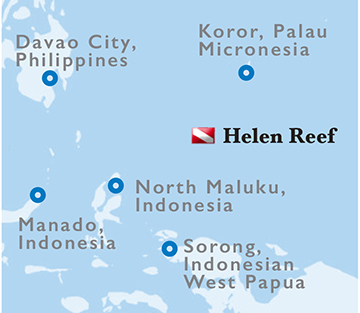
Dear Fellow Diver, Having dived all over the world, what could be better than joining an exploratory trip to hunt for virgin reefs and scads of fish in waters rarely dived? So, I joined a January 14-day adventure aboard the 170-foot Solitude One to travel 27 hours and 400 miles south from Koror to Palau's Helen Island, populated by four rangers and their families. I didn't know what to expect. Most of the crew didn't either.
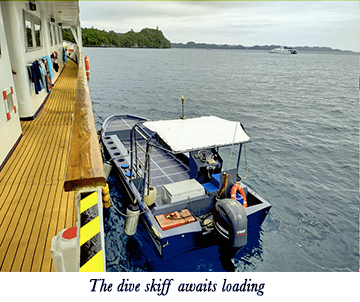
The next day, we were briefed on using a reef hook and an SMB, told to stay within recreational limits and no solo diving, and reminded there was no emergency help or chamber within hundreds of miles. They gave each diver an SMB and a Nautilus LifeLine Marine Rescue GPS to signal the Solitude One if carried off by a current. I checked out the camera room, which accommodated eight large and many smaller cameras, with plenty of electrical outlets. Late in the day, some passengers began asking about our location without getting much of a response, as if something was secret, until finally, we learned we were 17 hours behind schedule due to a malfunctioning shaft. We would not arrive until late the next day, and there would be no diving. So I passed my time propped up in bed, rocking back and forth in beam swells, editing photos, and studying fish books. Thankfully, I had a comfortable cabin with a queen bed, shelves, a nightstand, and a modern bathroom with a large shower; my sink had an unrepairable leak, so it had no hot water, and the bed lights and some USB outlets didn't work, but I'd survive. In the afternoon, flocks of seabirds began to appear, and soon, 44 hours after departure, we motored through the channel into Helen Reef's large lagoon. We celebrated with cocktails on the ship's bow, anchored off a palm-studded atoll. In the morning, the Solitude One nosed back through the channel to the southern end of the atoll. I slipped into my wetsuit on the spacious enclosed dive deck and headed to the stern and the two pangas loaded with our tanks and BCDs. The swells made climbing into the small, cramped pangas tough, and with eight divers and two divemasters on my panga, it was difficult to don my BCD and fins. With the crew's help, we all managed. After a short ride, divers got the OK to roll in. I hit the water, made a quick weight check, and dropped into the mild current that took us leisurely along the wall with no bottom in sight. With our guide leading, we four divers drifted in the 80-foot visibility, engrossed in a school of black and yellow pyramid butterflyfish cascading over the wall. A school of midnight snappers patrolled the reef as we drifted along, looking at the colorful reef, but our guide, Joe, impatiently rushed ahead. At the dive's end, the panga that brought us picked us up, ensuring a proper count. After the dive, Joe explained why he went so fast: "This is an exploratory trip; we need to explore." Thankfully, the guides rotated daily, and the other three let us move leisurely to observe and photograph. A couple of them hovered over me almost too much -- I was older than the other three divers -- but with the strong currents, it was comforting to know they were watching. On deck, the crew was always helpful.
Knowing that the Solitude One had made this exploratory journey before the pandemic, I figured they'd have an idea where to dive, but none of the crew had been here: their site knowledge was limited to what they had heard from the rangers and others. Diego used Google Earth to pinpoint corners where he guessed there might be fish action. Briefings were little more than: "We will try diving north of the channel where there may be a coral garden" or "According to our chart, the depth is 70 feet." Then we'd go check things out. For the afternoon dive, there was too much surge to dive the top of the wall, and the wall itself didn't have a lot of healthy coral, but rather, quite a bit of green algae, punctuated with colorful sea fans and gorgonians. After seeing a gray reef shark and a whitetip, I entertained myself with macro subjects like bright yellow clown coral blennies. I was disappointed in the limited diversity of reef fish; I had learned that Helen Reef has but one endemic fish, a wrasse.
On just about all our dive days, we had four dives. Music woke us at 6:00 a.m. for toast, fresh fruit, and a briefing. The first panga would load at 7:00 a.m., followed shortly by the second. After the dive, we'd have a hot breakfast and dive again around 11:30, followed by lunch. The afternoon dive would be around 3:30, followed by great snacks -- hot empanadas, maybe pizza or egg rolls, or warm cookies -- with a night dive around 6:30 or 7:00 p.m. All meals were buffet, beginning with a hearty breakfast of eggs, fruit, potatoes, warm fresh bread, French toast, and mango or banana pancakes. Occasionally they offered bacon or sausage, something akin to a hot dog. Or fried SPAM, which the G.I.s introduced to the islanders during WWII. Fresh fish -- fried, sauteed, sashimi -- was a lunch and dinner staple -- along with chicken, beef, or pork -- and salads and vegetables (near the end of our trip, it became a matter of how many ways the chef could prepare pumpkin and squash). I loved their lasagna, and one evening, I stuffed myself on chicken wings. One of the best desserts was a flan-like custard. They accommodated everyone's dietary needs, often with separate plates set aside. Chips, crackers, cookies, and fresh fruit were always around for the inveterate snackers. At the end of our fourth day, we were offered three choices: stay at Helen Reef with limited diving (I had logged 14 dives); try to dive the unprotected islands of Pulo Anna and Sonsorol, where the swells could be prohibitive; or head back to Palau. We voted unanimously to head for the excellent diving in Palau and the Rock Islands. Later, we were told we'd be stopping at the remote islands of Pulo Anna and Sonsorol, which we had voted not to visit. Turns out, the Solitude One was on an undisclosed mission to deliver supplies, with three planned stops, beginning with Tobi, 40 miles off the route to Palau. The next morning, I watched as box after box was tossed into a panga. Most had a single name scribbled on the side, "Jesse," "Ines K.," or "Matthew." In thanks, the islanders gave us dozens of fresh coconuts. Then, north to Pulo Anna -- population 10 -- where the people had no panga, and it was unsafe to unload the Solitude's pangas, which had to be lifted by crane from the boat's top deck. We left with their freight. We arrived at Sonsorol -- population 100 -- the following morning and delivered more goods.
At last, off to Palau. We bounced and swayed all day and into the night, making sleep difficult -- some slept in the bean bag chairs in the small salon -- but after midnight, the seas calmed, and in the morning, I cheered up as two larger and more comfortable pangas came from Koror to host our diving. At Palau, I logged 16 dives, which were generally better than those at Helen Reef. One afternoon, we had an exciting drift at Blue Corner in a powerful current. Three of us hooked in, but our guide and our other buddy were nowhere to be seen. I tried to look behind, but the current was so strong it could whisk my mask off my face. I watched the parade of reef sharks, some making passes over my head, and after 10 minutes, I felt a squeeze on my leg. Our guide had crawled across the reef to ensure we were OK. We unhooked and drifted to where he had left our other buddy. As we continued drifting, we passed plenty of jacks, tunas, and scads of colorful reef fish. I logged 75 minutes on this dive in warm water, which ran between 78F and 82F throughout the trip. On another dive, I saw a rare tinker butterflyfish and blueback pygmy angelfish in a cavern as well as lots of a newly described species called white-axil damsel.
On our last day, we snorkeled with blacktip sharks, had lunch on a beach, and visited the Milky Way, where our dive guides filled buckets with chalky-white limestone mud from the shallow bottom. It smelled like rotten eggs. Most of us were put off, but after one covered herself with it, another followed, and soon each of us was covered in the malodourous mud. Giggling like a bunch of school children, we jumped into the water to wash it off. If you think this sounds silly, you're right. After this bit of fun, I reflected on my trip. It was somewhat a disappointment. While it's interesting to take a long voyage to an unpopulated place with rarely-dived reefs, an 800-mile round trip for only four days of pretty good diving wasn't worth the journey, especially after losing two days of diving that most likely could have been avoided. In fact, one of our fellow passengers is seeking a $1000 cash refund for missing two out of ten promised diving days, a fault of the vessel, not the weather. We've been offered a $1000 credit, which seems to be a standard in the diving industry for attempting to appease customers who live on the other side of the globe and would be required to return to collect. That said, it was an exploratory trip, and one must realize it's better to have high hopes than high expectations, which may not be met. There aren't many opportunities for divers to explore, so it was worth giving it a shot. While this trip didn't work out, maybe the next one I take will. As for Palau, I won't go exploring again because the known sites are just about as good as it gets. -- F.L. Our undercover diver's bio: As a child, I poured over National Geographic underwater articles. I got certified in 1991 while stationed at Andersen AFB, Guam, and my first dive trips were to Palau and Truk. I have made more than 2,000 dives, mainly in Florida but also in the Philippines, Indonesia, the Revillagigedo Islands, the Sea of Cortez, and the Red Sea.
|


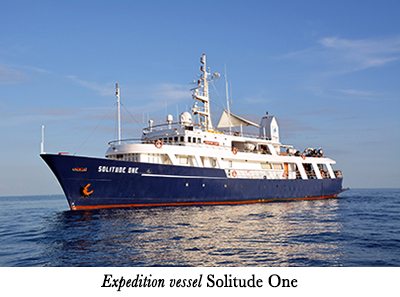 The Solitude One carries 19 crew members and 22 passengers -- we had 18 passengers, Americans, Germans, and Brits (two were named John and Paul, but no George or Ringo). Our cruise director, Diego, gave a safety briefing shortly after our 8 p.m. departure, emphasizing that it would be a rough crossing and to take seasick meds if needed (many divers would suffer from mal de mer). Then we sat down to an excellent meal, seafood chowder, perfectly cooked roast beef, pasta, and veggies -- before turning in. It was a long, bumpy night.
 After the second dive, the Solitude One returned to the lagoon, and just as I finished showering, an alarm went off. Dripping wet and in my birthday suit, I grabbed my robe and life vest and quickly ran for the stairs, but it was a false alarm set off when anchoring (when it happened
again, I ignored it). The crew decided it was
safer if the liveaboard stayed in the lagoon, so
for the remaining dives, we rode the pangas for
the long trip through the channel to dive the
nearby walls, which limited our choice of dive
sites.
After the second dive, the Solitude One returned to the lagoon, and just as I finished showering, an alarm went off. Dripping wet and in my birthday suit, I grabbed my robe and life vest and quickly ran for the stairs, but it was a false alarm set off when anchoring (when it happened
again, I ignored it). The crew decided it was
safer if the liveaboard stayed in the lagoon, so
for the remaining dives, we rode the pangas for
the long trip through the channel to dive the
nearby walls, which limited our choice of dive
sites.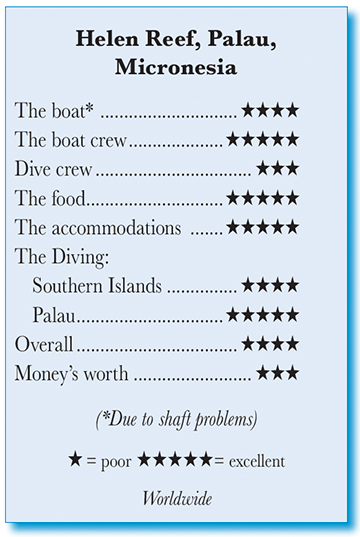 On our last dive of the day, things got more
exciting when the crew said we would ride the tide
through the channel into the lagoon. Without local
knowledge, they dropped us into a strong outgoing
current that carried us out to the ocean at
an uncontrollable speed. We aborted the dive. We
learned that the ocean swells were pushing so much
water over the atoll into the lagoon that it poured
back out through the channel with such force that
it reversed the incoming tide. Once we figured it
out, we dived the channel several times, and scores
of jacks and snappers, clouds of fusiliers, gray
reef sharks, turtles, and bumphead parrotfish made
it a superb dive. One day I was among hundreds
of Moorish idols. We also made three dives in the
lagoon, two near the ranger station, hoping to see
the three resident tiger sharks, but to no avail.
On our last dive of the day, things got more
exciting when the crew said we would ride the tide
through the channel into the lagoon. Without local
knowledge, they dropped us into a strong outgoing
current that carried us out to the ocean at
an uncontrollable speed. We aborted the dive. We
learned that the ocean swells were pushing so much
water over the atoll into the lagoon that it poured
back out through the channel with such force that
it reversed the incoming tide. Once we figured it
out, we dived the channel several times, and scores
of jacks and snappers, clouds of fusiliers, gray
reef sharks, turtles, and bumphead parrotfish made
it a superb dive. One day I was among hundreds
of Moorish idols. We also made three dives in the
lagoon, two near the ranger station, hoping to see
the three resident tiger sharks, but to no avail.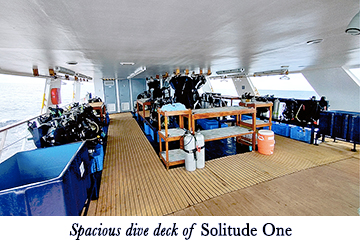 Clearly, the islanders depend on these deliveries. But why the secret? It wouldn't have stopped anyone from coming. Furthermore, at the crew's request, we had voted to head straight to Palau, then we took this preplanned detour and lost another day of diving.
 I've dived Palau since the '90s. The shore-based companies are capable of perfectly timing their dives with enough current for big fish action but not in so strong that it would break your reef hook, as it did for a couple of our divers. Unfortunately, the Solitude One crew lacked knowledge about Palau's currents. At the Ulong Channel dive, where we headed off to see the world's largest lettuce coral, we never made it because the current changed and took us back to our starting point. At Siaes Tunnel, the current was so strong we didn't reach the tunnel's main entrance; instead, we had to dart into one of the windows where divers usually exited. It seems even Palau was an exploratory dive for this crew.
 Divers Compass: Deep South Itinerary 13-night, deluxe cabin, $6,305/ person, diving permits $130, fuel surcharge $30-$50/day, room tax $10/day, nitrox $135 . . . . nitrox was 28-32; they have aluminum 100s, 80s, 63s, 40s, and 19s. . . . . they sell Nautilus Lifelines, SMB, reef hook, and common replaceable spares and rent equipment, including dive computers . . . . local beer $4/can; mixed drinks $8, and wine $40 a bottle . . . . The Solitude One spends many months a year diving the Philippines . . . . Only United flies to Palau (RT from Florida was under $2000) . . . . I arrived a couple of days before departure in case of airline hang-ups . . . Sea Passion Hotel and Palau Royal Resort have snorkeling areas, and shore dive operations will pick you up from most hotels . . . .
I want to get all the stories! Tell me how I can become an Undercurrent Online Member and get online access to all the articles of Undercurrent as well as thousands of first hand reports on dive operations world-wide

| Home | Online Members Area | My Account |
Login
|
Join
|
| Travel Index |
Dive Resort & Liveaboard Reviews
|
Featured Reports
|
Recent
Issues
|
Back Issues
|
|
Dive Gear
Index
|
Health/Safety Index
|
Environment & Misc.
Index
|
Seasonal Planner
|
Blogs
|
Free Articles
|
Book Picks
|
News
|
|
Special Offers
|
RSS
|
FAQ
|
About Us
|
Contact Us
|
Links
|
3020 Bridgeway, Ste 102, Sausalito, Ca 94965
All rights reserved.