
 |

 Email Signup
|
Subscribe
|
Login
Email Signup
|
Subscribe
|
Login
For Divers since 1975 The Private, Exclusive Guide for Serious Divers Since 1975 |
"Best of the Web: scuba tips no other source dares to publish" -- Forbes |
Flotsam & JetsamContents of this Issue: Uepi Resort, Solomon Islands, South Pacific Investing in Digital Camera and Expensive Strobes? An Aging Liveaboard, a Dangerous Dive Deck Death and the Full-Face Snorkel Masks The Diver & The Cook, Fascinating Nonfiction DEMA Working Hard To Pass The Dive Boat Act Another Liveaboard Lost in the Red Sea Two More Liveaboards Lost to Fire Editorial Office: Ben Davison Publisher and Editor Undercurrent 3020 Bridgeway, Suite 102 Sausalito, CA 94965 from the November, 2024 issue of Undercurrent
Octopuses Need Oxygen. Onlookers on the Monterey Bay wharf in California had an "incredible sighting" on October 28, when over the course of an hour, more than two dozen octopuses surfaced. While it was exciting for the onlookers, it might mean bad news for the octopuses, says Monterey Bay Whale Watch. "Due to the millions of anchovies that have been in the harbor for weeks depleting the oxygen supply, we think these beautiful cephalopods were seeking more oxygen at the surface!" Some were attacked and eaten by gulls and otters, but others managed to get away by releasing ink or submerging quickly, making "quite the sight" for those at the "right place at the right time," they posted on Facebook. Where Did Milton-Affected Sharks Go? Storms will certainly displace sharks, and the shark tracking app Shark Tracker reveals Florida's sharks moved out of the way of Hurricane Milton. Sharks have been documented leaving the Tampa Bay area ahead of storms in the past, and a more recent paper showed that on Florida's east coast, sharks moved out of the way of the big storms when other marine life did not. So, where do sharks go? When a storm disrupts a shark's normal behavior, their goal is typically to get to deeper water, according to Greg Skomal of the Massachusetts Division of Marine Fisheries. There is some variation by species, but particularly the smaller sharks go deep. (Smithsonian Magazine)
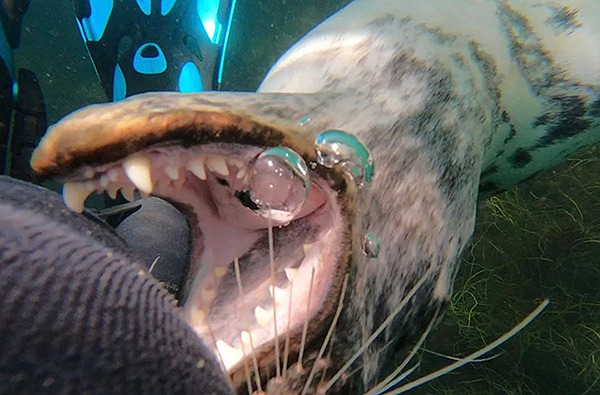
A Lucky Shot. While photographers can sit through an entire dive waiting for a unique shot, 26-year-old Lucy Manning just reacted spontaneously to get this photo of a grey seal about to bite her thigh. Diving around Lundy Island, in Devon, off the coast of England, she felt a seal nibble on her fin and quickly took this shot just as he was about to nip her. "There were loads of them floating about, and they're so playful. They're really cute, but they do have teeth." She said she was a bit scared but wasn't injured. (Kennedy News and Media) Robotic Whale Shark Lands Chinese Aquarium in Hot Water. There were many reasons that visitors to Xiaomeisha Ocean World in China could be forgiven for grumbling: The high cost of admission, long queues, and the poor condition of the aquarium. But they were excited to see a mighty whale shark up close. Not so. Rather than exhibiting a real whale shark - which can grow up to 60 feet in length - guests were furious when the animal turned out to be a giant robotic replica. They noticed gaps in the torso, where parts of the robot had been joined together. We say, better a robot than a captive whale shark. www.youtube.com/watch?v=XPwZyWKP5Lo Bird's Head Blog. Burt Jones and Maurine Shimlock report that new conservation strategies may soon bolster protection for Indonesia's Bird's Head Seascape's sharks and rays. The International Union for Conservation of Nature (IUCN) recently named 122 Important Shark and Ray Areas in Asia, with 43 designated in Indonesia, including 12 in West Papua (the Bird's Head Peninsular) and Papua. https://tinyurl.com/2fe84rpr Flying Needlefish are Dangerous. A 36-year-old Italian surfer was killed in a freak accident on October 18 in Indonesia's Mentawai Islands when a needlefish leapt from the water and impaled itself in her chest. Needlefish have a long, narrow beak filled with sharp teeth, can grow up to three feet long, and cruise just under the surface. Three years ago, we reported that "a 16-year-old girl jumped from the liveaboard MY Keama at Ari Atoll in the Maldives and collided with a needlefish. She was seriously injured when its needle-tip snout penetrated her neck and brain." All for a Hearty Drink. The wreck of the James R. Bentley, a 170-foot-long schooner, has sat at 165 feet on the bottom of Lake Huron since 1878. In September, a team of divers descended to it just to collect a few scoops of the 30,000 bushels of rye the vessel carried. Chad Munger, the founder of Mammoth Distilling, bankrolled the venture, hoping to sprout the seeds and grow rye so he could recreate a classic old whiskey. The divers did collect the seeds, and Munger hustled them to Michigan State University, where scientists attempt to sprout them. After several weeks of various techniques, they remained dormant as ever, dashing Bentley's dreams of creating a whiskey like our forefathers sipped. (Carsa Giamo, NY Times) Necessity is the Mother of Invention. Cozumel had problems with the amount of sargassum weed washing onto its beaches, so people there are testing the effectiveness of artificial reefs made of the weed combined with artificial coral made with algae. The project is part of a program run by the banking institution BBVA and the Riviera Maya Hotel Association. A Fisherman Throws it Back. An unnamed fisherman in the Pelion region of Greece's Aegean coast, who found the body of a 74-year-old snorkeler in his nets and threw it back into the sea, has been found guilty of manslaughter. The snorkeler had been reported missing to the authorities the previous day. Instead of passing on news of his discovery, the fisherman had initially left the scene, Coast Guard officers told the court in the city of Volos. The body was later spotted 15 feet from shore. When Hyperbaric Facilities Might Not Save Your Life. We recently wrote about two rebreather divers dying in Malta. One was conscious and happily gave a thumbs-up when he entered the recompression chamber. But he didn't survive. It turns out a senior consultant left only a junior trainee to monitor the recovery and then went home after instructing the trainee to maintain phone contact with him and to avoid making independent major decisions. Still, something went wrong. The consultant apparently misdiagnosed the diver's condition over the phone, suspecting oxygen toxicity rather than DCI, and he received excessive nitrogen, exacerbating his DCI. The consultant could face a prison sentence of up to four years and a hefty fine if found guilty of involuntary manslaughter. Lost and Found. When Undercurrent subscriber Ken Kurtis visited the Atlantis Resort in Dumaguete, Philippines, he inadvertently left behind a little portable luggage scale he was rather fond of. Luggage scales are useful to traveling divers who are inevitably near baggage weight restriction limits. That was before the COVID epidemic. When he returned on a trip in September this year, more than four years later, it was waiting for him. It's the small things that make the difference. Kudos to the people at Atlantis Resorts. |



I want to get all the stories! Tell me how I can become an Undercurrent Online Member and get online access to all the articles of Undercurrent as well as thousands of first hand reports on dive operations world-wide

| Home | Online Members Area | My Account |
Login
|
Join
|
| Travel Index |
Dive Resort & Liveaboard Reviews
|
Featured Reports
|
Recent
Issues
|
Back Issues
|
|
Dive Gear
Index
|
Health/Safety Index
|
Environment & Misc.
Index
|
Seasonal Planner
|
Blogs
|
Free Articles
|
Book Picks
|
News
|
|
Special Offers
|
RSS
|
FAQ
|
About Us
|
Contact Us
|
Links
|
3020 Bridgeway, Ste 102, Sausalito, Ca 94965
All rights reserved.