
 |

 Email Signup
|
Subscribe
|
Login
Email Signup
|
Subscribe
|
Login
For Divers since 1975 The Private, Exclusive Guide for Serious Divers Since 1975 |
"Best of the Web: scuba tips no other source dares to publish" -- Forbes |
What's In Belize's Blue HoleContents of this Issue: Panama, Misool, Caye Caulker, Rapa Nui The Tragedy of the Liveaboard Industry The Call for Regulation of Liveaboards Thailand Bans Cameras for New Divers Editorial Office: Ben Davison Publisher and Editor Undercurrent 3020 Bridgeway, Suite 102 Sausalito, CA 94965 from the May, 2025 issue of Undercurrent
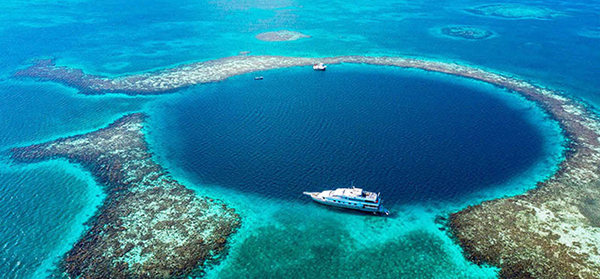
Sinkholes are natural depressions that form when rock dissolves or collapses, creating deep voids in the ground. Oceanic sinkholes, like Belize's blue hole, typically originate from limestone caves that formed thousands of years ago when sea levels were much lower. Over time, as rising waters flooded these caves, some collapsed, leaving behind the massive, submerged sinkholes we see today. Belize's Great Blue Hole, which is on every diver's bucket list, measures over 1,043 feet across and about 407 feet deep. In 1971, by dynamiting a route through the surrounding shallow coral, Jacques Cousteau and his Calypso crew explored the Great Blue Hole for their television series, The Undersea World of Jacques Cousteau. He was so enthralled he ranked it among his top ten scuba diving sites worldwide. Divers don't see it that way today. Everyone wants to dive it once, a been there, done that kind of dive. Cousteau provided the first widely publicized visual evidence that the Great Blue Hole had once been a dry limestone cave -- formed during the last Ice Age. The submerged stalactites support geological theories showing that the cave had collapsed and flooded as the oceans rose. In later years, divers also began documenting the marine life inhabiting the sinkhole, including reef sharks and groupers. Along Comes Branson In 2018, Aquatica Submarines, in collaboration with Fabien Cousteau, Richard Branson, and sub pilot Erika Bergman, used advanced sonar technology to create the first complete 3D digital model of its interior. They encountered a thick hydrogen sulfide layer at 300 feet, blocking out oxygen and light and creating a dead zone where no marine life could survive. Below this, the water was completely anoxic, preserving everything that had fallen in and sunk to the bottom without decomposing due to the extreme conditions. Bergman explained that a thick layer of toxic hydrogen sulfide stretched across the sinkhole, preventing oxygen from getting deeper. "We found conchs and hermit crabs that had fallen into the hole and suffocated," she said, "as well as a two-liter Coke bottle that had made its way 407 feet deep, and a lost GoPro camera full of someone's holiday photos." Alongside the trash were two human bodies believed to belong to two of the three divers who were lost during a previous expedition. "We found the resting place of a couple of folks, and we respectfully let the Belize government know where we found them. Everyone decided that we would just not attempt any recovery. It's very dark and peaceful down there; just let them stay," Bergman said. The mapping also revealed a calcium carbonate layer at 290 feet, evidence that a thriving coral reef had once existed here before being submerged by rising seas. Additionally, divers observed sand falls cascading down the sinkhole's walls, which suggests the Great Blue Hole is slowly filling in over time. The expedition was broadcast live on the Discovery Channel. A Time Capsule For Earth's Climate In November 2020, scientists extracted a nine-meterlong core of sediment from the Great Blue Hole's floor, revealing a 1,885-year record of climate change in the Caribbean. Each layer of sediment acts like a page in a history book, showing how sea temperatures, storm activity, and even human influence have changed over time. The findings confirmed that sea temperatures have been rising for nearly 2,000 years, with long-term climate patterns like "El Niño" and the "Atlantic Multidecadal Oscillation" playing a major role. But the most surprising discovery was evidence of modern human impact. The study found a sudden change in carbon composition after 1900, linked to the Industrial Revolution and the rise of fossil fuel emissions. The Belize Blue Hole is now a record of human-caused climate change. From a story by Scott Travers (Fortune Magazine), news.com.au, and other sources) |



I want to get all the stories! Tell me how I can become an Undercurrent Online Member and get online access to all the articles of Undercurrent as well as thousands of first hand reports on dive operations world-wide

| Home | Online Members Area | My Account |
Login
|
Join
|
| Travel Index |
Dive Resort & Liveaboard Reviews
|
Featured Reports
|
Recent
Issues
|
Back Issues
|
|
Dive Gear
Index
|
Health/Safety Index
|
Environment & Misc.
Index
|
Seasonal Planner
|
Blogs
|
Free Articles
|
Book Picks
|
News
|
|
Special Offers
|
RSS
|
FAQ
|
About Us
|
Contact Us
|
Links
|
3020 Bridgeway, Ste 102, Sausalito, Ca 94965
All rights reserved.