
 |

 Email Signup
|
Subscribe
|
Login
Email Signup
|
Subscribe
|
Login
For Divers since 1975 The Private, Exclusive Guide for Serious Divers Since 1975 |
"Best of the Web: scuba tips no other source dares to publish" -- Forbes |
Wild Fish Can Recognize HumansContents of this Issue: Coral Reefs Pass the Climate Tipping Point SCTLD Spreads to Little Cayman Corn Island, Chuuk Lagoon, Galapagos Wild Fish Can Recognize Humans Your Fellow Divers Need Your Report on Your Last Dive Trip Ocean Ramsey: The Controversy Continues Rip Currents and Surviving Them The Biter Bit: Revenge of the Bonito Those Boat Propellers are Dangerous A Child Goes Missing Underwater: Update Orcas in the Gulf of California Are Attacking Great White Sharks Editorial Office: Ben Davison Publisher and Editor Undercurrent 3020 Bridgeway, Suite 102 Sausalito, CA 94965 from the November, 2025 issue of Undercurrent
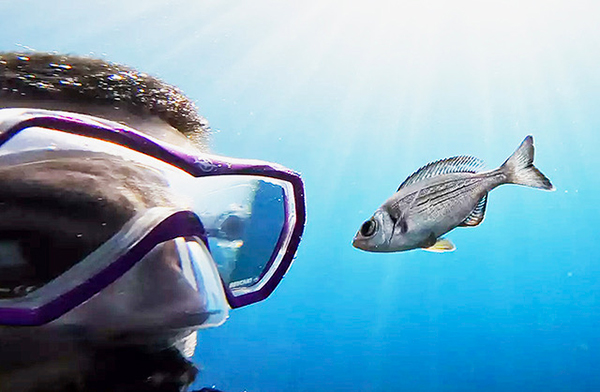
On occasion, Undercurrent readers have written in their reader reports that when they return to a spot to dive, the fish seem to recognize them. While one might get a little suspicious of divers who claim a fish recognizes them a year later, if you dive the same spot for a few days, you may be right. For years, scientists at the Max Planck Harvard Mediterranean Research Center noticed fish would follow specific divers, usually those who had previously fed them, while ignoring others. The fish didn't just beg indiscriminately; they seemed to recognize individual humans. To test this, researchers conducted controlled experiments to determine if the fish actually differentiated between humans based on visual cues. "Do wild fish have the capacity or motivation to recognize us?" asked Maëlan Tomasek, a doctoral student at the Institute. A Willing School of Subjects The experiments took place 26 feet underwater, where the free-swimming fish were accustomed to divers. During the initial training phase, assistant Katrinka Soller wore a bright red vest and swam a 164-foot path while feeding any fish that followed. Over 12 days, she gradually removed visible cues like the vest and hid the food, rewarding fish only if they swam the whole distance behind her. Two seabreams, common in the area, emerged as the most engaged participants, returning day after day. Ultimately, about 20 fish consistently followed Soller during swims, and she learned to recognize some of them individually. With this relationship established, the researchers moved to the next phase: testing whether the fish could tell Soller apart from another diver. The Two-Diver Test Soller and Tomasek entered the water together, wearing different variations in wetsuit colors and fins, and swam in opposite directions. On the first day, the fish split between the two divers. But by the second day, many followed Soller exclusively, as Tomasek never fed them. To confirm learning, the team tracked six specific fish and found four clearly preferred Soller over time. "They weren't just following out of habit," says Tomasek. "They were conscious of both divers, testing each one and learning that Katrinka produced the reward at the end of the swim." However, when the same test was repeated with both divers wearing identical gear, the fish could no longer tell them apart. This indicated that the fish relied on visual details--likely color patches or gear design -- to recognize individuals. "Fish have color vision, so it makes sense they'd use it to tell us apart," says Tomasek. Fish Studying Humans Interestingly, this visual recognition mirrors how divers identify each other underwater. Because masks distort facial features, divers often rely on wetsuits, fins, or gear to know who's who. The fish, it turns out, were doing exactly the same. "They would approach and scrutinize our faces and bodies, as if studying us," says Soller. The findings support longstanding anecdotal claims that fish -- and potentially other wild animals -- can build specific relationships with people. It also hints at cognitive abilities we often overlook in fish. "These animals navigate complex environments and interact with many species. Of course they can learn who we are," says senior author Alex Jordan. "It might seem strange to think about forming bonds with a fish," says Tomasek. "But this study shows that human-animal relationships can cross millions of years of evolutionary separation -- if we pay attention." A synopsis of a study published in Behavioral Biology. |



I want to get all the stories! Tell me how I can become an Undercurrent Online Member and get online access to all the articles of Undercurrent as well as thousands of first hand reports on dive operations world-wide

| Home | Online Members Area | My Account |
Login
|
Join
|
| Travel Index |
Dive Resort & Liveaboard Reviews
|
Featured Reports
|
Recent
Issues
|
Back Issues
|
|
Dive Gear
Index
|
Health/Safety Index
|
Environment & Misc.
Index
|
Seasonal Planner
|
Blogs
|
Free Articles
|
Book Picks
|
News
|
|
Special Offers
|
RSS
|
FAQ
|
About Us
|
Contact Us
|
Links
|
3020 Bridgeway, Ste 102, Sausalito, Ca 94965
All rights reserved.