
 |

 Email Signup
|
Subscribe
|
Login
Email Signup
|
Subscribe
|
Login
For Divers since 1975 The Private, Exclusive Guide for Serious Divers Since 1975 |
"Best of the Web: scuba tips no other source dares to publish" -- Forbes |
Bahamas Aggressor II:Contents of this Issue: A Regulator Attached Backward to a Tank Explore Vava'u, AX-Factor Dive, Tonga Whale Rescue Encapsulated in Award-winning Photo Captain Ahab, Eat Your Heart Out A Diver's Preventable Death in the Azores Many Rubber Boats Have No Ladder Fellow Student Shares Child's Training Death Story Solmar V: Canceled Trips, No Refunds What? Another Liveaboard Fire? Editorial Office: Ben Davison Publisher and Editor Undercurrent 3020 Bridgeway, Suite 102 Sausalito, CA 94965 great boat, but the reefs have taken a hit from the January, 2026 issue of Undercurrent
Dear Fellow Diver,
When the BVI Aggressor relocated to the Bahamas last May, it upped the ante. The Bahamas Aggressor II, as it was renamed, is beamy and quite plush (which the much smaller Bahamas Aggressor I is not), and I was delighted to book a September trip. The diving is easy -- you simply hop off the transom and climb up its large ladders at the end of each dive. My last Bahamas trip was the fall of 2017 (see my feature here https:// tinyurl.com/2aa548p4), and though I noted then some algal buildup on the reefs, they were mostly in decent to good shape. Sadly, that is no longer the case. It's not just the Bahamas that's affected, but all over the Caribbean that we see reefs suffering from algal buildup, SCTLD (stony coral tissue loss disease), and environmental stress. Is this the new normal? I think it is. The baseline has shifted from the lush reefs I remember from the 1980s and '90s. That said, I found a lot to like about diving from the Bahamas Aggressor II, and I will book the boat again when I get the chance. My buddy and I arrived in Nassau during a September downpour that left streets flooded -- the ride from the airport to the dock was a slow, wet slog. Hurricane season always offers a chance of bad weather, but I awoke to sun on the second day and good weather that abided for the entire trip; I felt fortunate. We were welcomed by captains Ramon and Javier from Mexico; chef Maria and engineer Darwin were also Mexican. Cruise director Alex, an affable South African, attended to our comforts. Dive pro Matt hailed from the U.K. via the Dominican Republic, while divemasters John and Jon were Americans. The attitude and service of this diverse crew did them credit. Fifteen divers from all over the U.S. joined this special 10-day itinerary (the boat can take 20 guests). We began the trip with a fire drill, and then the usual checkout dive near Nassau, a great chance to fine-tune my weighting.
I think next to diving, food is a liveaboard's most important offering, and on my trip it was quite ambitious, though it has likely changed since chef Maria moved back to Mexico (her choice; the Bahamas are not ousting immigrants willy-nilly). She prepared a variety of international dishes, and, at each dinner, told us about her inspiration. Dinner was served plated, with a main dish -- my favorite: garlic chipotle lobster tails -- plus veggie sides, and of course, lots of desserts. There were always vegetarian options. Breakfast always included eggs your way plus pancakes, waffles, French toast, sausage, bacon, and specialties like croissants filled with a cream and peach compote. The snack between morning dives was always a sweet baked treat like chocolate cookies, cinnamon rolls, or apple cake. Lunch, served buffet-style, began with soup (my favorite was the Mexican-style pozole). Taco Tuesday and Cheeseburgers in Paradise are classic liveaboard fare, but lunches also included Peruvian-style flank steak and pesto snapper. Afternoon snacks were savory, and my favorite were arepas, tasty pastries filled with meat and cheese.
Its underside was covered with deepwater gorgonias, and I lolled under the cage, admiring their craggy black outlines. As we drifted slowly up the sides of the cage, I relished the sponges growing on the mesh; where there were holes in the cage, I stuck my head inside to behold lots of fish enjoying the safety of the enclosure. Near the top, in 45 feet, we had a sloping view of the cage and twice saw a school of midnight parrotfish cruise its surface. Cubera snapper swam by, as well as schools of smaller fish. We emerged with big grins! I would have loved to stay longer, but the Aggressor limited dives to one hour, including the safety stop. I understand why they are strict about 60-minute dives, but I don't like it, especially since I always surface with 1500-1200 psi. The only boat where I've been able to dive my own profile is the Bilikiki in the Solomons, where my buddy and I were sometimes down for 90-120 minutes! If the Aggressor could ratchet up the dive time a bit, maybe 70-75 minutes, I'd love it.
En route to Eleuthera, the boat stopped near Staniel Cay so we could snorkel Thunderball Grotto, a small site that looks like nothing from the outside, but James Bond made it famous. As we snorkeled under the island's edge and emerged into the domed grotto, with light streaming through the opening at its top, I understood why Hollywood chose it for not only two Bond movies ("Thunderball" and "Never Say Never Again") but also "Splash" and "Into the Blue." It's small, but good camera work made it seem big enough for Largo's submarine and nuclear weapons! Rocky Dundas Cay also boasted a grotto, and a shallow swim-thru brought us into a grotto under the island, another domed space with a natural oculus. A huge school of terminal phase stoplight parrotfish seemed to have a home there.
On six dives, the crew put a sealed chum bucket in the water, which attracted gray reef sharks and livened up those sites. At the Austin White wreck, the chum was a particular blessing since it is otherwise bland. The crew was notably personable and kind, helping with gear and wrapping us in warm towels after night dives. The crew accommodated everyone's needs, including one admirable diver who had suffered from abdominal cancer and wore a small bag -- he was a terrific diver with the most positive attitude I've seen. He helped make the trip memorable. Regardless of my disappointment with the degradation of the reef, sadly, the new normal, the Bahamas Aggressor is a great boat with a great crew, and when I want to go diving close to home, it will be near the top of my list. -- A.E.L Our undercover diver's bio: AEL, who has made more than 4400 dives, has written for Undercurrent for over 20 years and wrote about the Philippines and Bali diving in two recent issues.
|

 = publicly available
 My buddy and I swam over the patch reef on the edge of The Lost Blue Hole, a dramatic, nearly perfectly circular underwater sinkhole, with a 100-feet in diameter and located about 10 miles east of Nassau. While it plunged into dramatic gloom on the way to its 200-foot bottom, 100 feet was as deep as I went. The walls were steep and stark, and the atmosphere spooky enough for a thrilling frisson. Unlike the Belize Blue Hole, this was loaded with life. Crustaceans galore lurked in the wall crevices, and coral patches around its rim were flush with creatures. I watched a massive Methuselah-aged green turtle having its carapace groomed by tangs and parrotfish. A dozen robust blue parrotfish streamed by, looking as tough as a fish with a smiling beak can look. Stingrays cruised the sand looking for food, while a large nurse shark lolled under a coral head. And the exhaled bubble streams coming through small holes in the substrate at the hole's edge made me feel like I was in a glass of Champagne. This was easily the best dive site of my 10-day trip on the Bahamas Aggressor II. And we got to dive it three times, including a night dive!
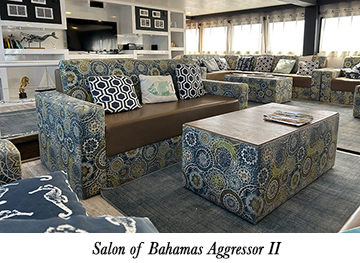
 The boat, 110 feet long and a beamy 25 feet wide, has a large superstructure
with a big salon filled with sofas, and one deck up, a large galley and dining
room. The capacious dive deck has several camera tables and convenient niches
(akin to mailboxes) for divers to store sunglasses, T-shirts, or other dry items
before a dive. On the top deck, lounge chairs for the sun bathers beckoned next
to a hot tub, where one could relax under a shaded cocktail deck with lots of
seating. Smokers were allowed here, and a couple
were on board. (I'm always tempted to ask why they
engage in heavy carbon monoxide loading before
diving, but that's their business, not mine.) So,
I'd often take to the lounge to read and snooze;
one diver who couldn't leave his work at home was
on his laptop in a corner every day.
The boat, 110 feet long and a beamy 25 feet wide, has a large superstructure
with a big salon filled with sofas, and one deck up, a large galley and dining
room. The capacious dive deck has several camera tables and convenient niches
(akin to mailboxes) for divers to store sunglasses, T-shirts, or other dry items
before a dive. On the top deck, lounge chairs for the sun bathers beckoned next
to a hot tub, where one could relax under a shaded cocktail deck with lots of
seating. Smokers were allowed here, and a couple
were on board. (I'm always tempted to ask why they
engage in heavy carbon monoxide loading before
diving, but that's their business, not mine.) So,
I'd often take to the lounge to read and snooze;
one diver who couldn't leave his work at home was
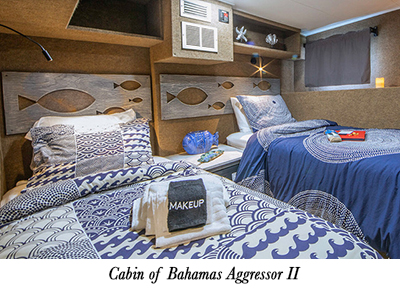
on his laptop in a corner every day.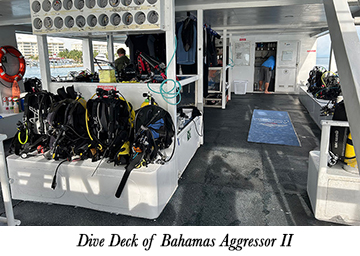 Cabins 3-8 are a lot roomier than the two bow
cabins; there are two staterooms on the main deck
off the salon with sliding glass doors and tiny
balconies. I booked cabin 2 in the bow as a single
and regretted choosing it. Its two bunks converge
at the bow, leaving a tiny triangular floor space
and an awkwardly configured bathroom. There were
two guys across from me in cabin 1 with the same configuration, and I wondered how they were able to make it work. Space was so tight that I used the second bunk as my wardrobe shelf. Maybe they were folks who traveled light, which no one has ever suggested I do!
Cabins 3-8 are a lot roomier than the two bow
cabins; there are two staterooms on the main deck
off the salon with sliding glass doors and tiny
balconies. I booked cabin 2 in the bow as a single
and regretted choosing it. Its two bunks converge
at the bow, leaving a tiny triangular floor space
and an awkwardly configured bathroom. There were
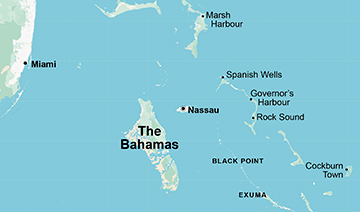
two guys across from me in cabin 1 with the same configuration, and I wondered how they were able to make it work. Space was so tight that I used the second bunk as my wardrobe shelf. Maybe they were folks who traveled light, which no one has ever suggested I do!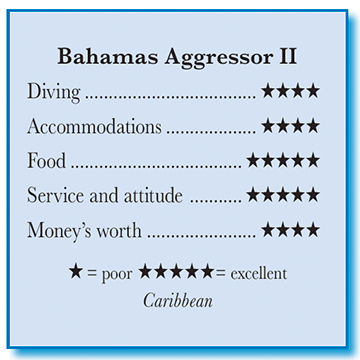 Because this was a 10-day itinerary, we were able to dive at remote sites around Eleuthera. (The staff updated the chart daily to show our route.) My favorite was Cobia Cage, a massive diamond-shaped prism of mesh constructed by The Cape Eleuthera Institute to raise cobia for food. This noble effort failed as aquaculture, but now it's an extraordinary dive site. The base of the cage, which looks like an alien spacecraft, is moored at 90 feet, and like most underwater structures, it's a fish magnet. On our first dive there, my buddy and I spent time looking at the nearby wall, with its dramatic contours, but the cage itself was so weird and so alive that we spent the next dive glued to it.
 Five of our dives were at two blue holes: Jake's Blue Hole off south Eleuthera and the Lost Blue Hole near New Providence. Jake's was, strictly speaking, not a blue hole but a tidal hole in the reef; when the tide is ebbing, you can feel the water being sucked into it. The dive staff were adamant that we not go into the hole, and once I felt the water suction, it was easy to comply. Nearby were dramatic pinnacles and a steep wall. Blue striped, white, and French grunts abounded, as well as Nassau and tiger grouper. But for a real blue hole experience, it was hard to beat the Lost Blue Hole. On my previous trip, we only dived it once, but on this trip, we dived it three times, late afternoon, night, and dawn, and it was glorious.
 One site with nearly perfect stony and soft corals was Jeep Reef in the Middle Exumas. Subject to strong tidal currents, it can't always be dived, so our captain timed our arrival with the tides. It's composed of a series of lush coral heads with big sponges (and no fibrous algae), perhaps because of the currents. I had difficulty navigating it because it was a field of smallish coral heads with no outstanding structures, but I kept my eye on the dive guide. The eponymous Jeep sunk amidst sponges and corals is easy to miss, partly because there are so many fish and critters, including a school of crevalle jacks. Jeep Reef had easily the healthiest coral I saw.
 DIVER'S COMPASS: Exuma-Eleuthera itineraries depart from Nassau, easily reached from the U.S. and Europe (Tiger Beach itineraries depart from Freeport). My twin cabin was $3395; deluxe is $3595, and balcony room $3995 . . . Aluminum 100s available for those enjoying extra gas; Nitrox is extra . . . The boat has full Mares rental gear, and though the staff does not make repairs, they are happy to loan you gear if you have an issue. I was charged $389 port fee for this 10-day trip . . . Beer, wine, and soft drinks were free, though one's first adult beverage turned you into a snorkeler . . . You must take a taxi from the airport to the boat dock, about US$50. U.S. dollars are accepted everywhere . . . One can buy internet access for about $40 for the trip for one device; I also had cellular service for over half the trip . . . Hyperbaric chambers are in both Nassau and Abaco.
I want to get all the stories! Tell me how I can become an Undercurrent Online Member and get online access to all the articles of Undercurrent as well as thousands of first hand reports on dive operations world-wide

| Home | Online Members Area | My Account |
Login
|
Join
|
| Travel Index |
Dive Resort & Liveaboard Reviews
|
Featured Reports
|
Recent
Issues
|
Back Issues
|
|
Dive Gear
Index
|
Health/Safety Index
|
Environment & Misc.
Index
|
Seasonal Planner
|
Blogs
|
Free Articles
|
Book Picks
|
News
|
|
Special Offers
|
RSS
|
FAQ
|
About Us
|
Contact Us
|
Links
|
3020 Bridgeway, Ste 102, Sausalito, Ca 94965
All rights reserved.