
 |

 Email Signup
|
Subscribe
|
Login
Email Signup
|
Subscribe
|
Login
For Divers since 1975 The Private, Exclusive Guide for Serious Divers Since 1975 |
"Best of the Web: scuba tips no other source dares to publish" -- Forbes |
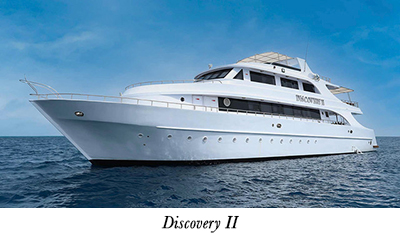
Discovery II, Red Sea, EgyptContents of this Issue: Lankayan Island Beach Resort, Malaysia Is Restoring Reefs a Waste of Effort? Your Reports Are Most Important A Circus Shark Tamer or Conservationist? A Free Ascent - the Last Resort? Part Il A Reason Not to Practice Free Ascents Not Yet Plain Sailing for the SS United States Editorial Office: Ben Davison Publisher and Editor Undercurrent 3020 Bridgeway, Suite 102 Sausalito, CA 94965 great safe diving, priced right from the September, 2025 issue of Undercurrent
Dear Fellow Diver,
I had initially booked my trip on the Tillis, but shortly after the Sea Story capsized and sank in November, Dive Pro Liveaboard, which operated both boats, canceled my booking. Having had a good trip previously on Discovery I, I chose its sister ship, the 37-meter Discovery II, which offered a similar itinerary in June and took fewer divers than most other liveaboards. Our first dive was a checkout at Small Gifton, about two hours from Hurghada. It was an easy dive to 60 feet on a sloping reef wall with lots of hard and some soft corals. Six-foot morays were plentiful, as were anemonefish and lionfish. Unlike Caribbean lionfish, these were out hunting during the day, making for a more dramatic display. At the end of the checkout, we were all required to shoot our SMBs, but snorkelers had invaded the surface, making the exercise less about proving we could operate our SMBs and more about target practice, hitting snorkelers instead. While we saw boats with snorkelers and divers at several sites during our trip, the sites were generally uncrowded. But to ensure we would climb aboard the right boat, Discovery II had a drop line to 5 meters, with the boat's flag on it so we could easily find it. With the raft of recent safety problems in the Red Sea, I was particularly attentive during the first day's video briefing, which covered everything from smoking (top deck only) to the location and use of fire extinguishers and evacuation procedures. Charging power was only available outside on the main deck and in the salon. With a crew of 10 on board, someone was always awake and patrolling the boat at night, which I confirmed several times with 3:00 A.M. trips to get drinking water. A "feeling" isn't data, but I felt that we had a safe boat and a crew that took safety seriously.
My cruise from Sunday through Friday offered 17 dives, including one night dive. Monday through Thursday, we had three daily dives (6:00 A.M., 10:00 A.M., and 2:30 P.M.), which began with thorough briefings. The three Egyptian divemasters, Peter, Khalid, and Ramadan, divided us 19 divers into two groups. Each group alternated being first on the dive deck to minimize congestion, dressing and boarding the two Zodiacs. Each held six divers comfortably. Once one group was safely off the boat with their divemaster, the other group immediately hit the dive deck to gear up, and the Zodiacs returned to pick them up. While the divemasters spoke English well, the rest of the crew had a more limited vocabulary. We had the same divemaster for the week, which was important because experience varied: two Korean honeymooners had 50 dives, half the divers had fewer than 150 dives, an instructor and three experienced divers had more than 1000 dives. (We were the only two Americans.) One diver paid for a dedicated divemaster. Khalid, our group's divemaster, was young, personable, very guest-oriented, and accommodated, whenever possible, my desire to dive at my own pace. The divemasters spent more time watching and keeping the divers together and managing air consumption on the officially 60-minute dives than they did finding unique critters. The first day, our dives were shortened by one diver who was consistently 10-15 feet below everyone and ran out of air first -- until I reminded her she'd have more air if she stayed shallower. On the second day, experienced divers were allowed to dive unguided, which my buddy and I then did for most dives, staying down for 70 minutes or more. Almost every dive was along a sloping reef or wall, making navigation a snap.
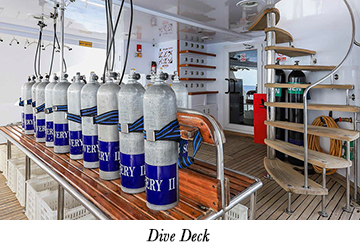
The daily rhythm, as on all liveaboards, is created by dives interspersed with meals, which the divemasters explained with the same joke I've heard on every recent liveaboard. It's funny the first time. "We ring the bell for dive briefings. We ring the bell for meals. If you don't know the difference, check your hair. If it's wet, it's time to eat. If it's dry, it's time for a briefing." For lunch and dinner, they served platters of traditional Middle Eastern salads, such as fresh cucumbers and tomatoes, and several main dish choices, such as grilled chicken, a fish soup, or pasta with meat sauce, plus hot vegetables. My only complaint was that we didn't have enough variety of Arabic food: falafel and foul were about all our Egyptian cook offered. Breakfast was eggs cooked to order, cold cuts and cheese, as well as fruit and yogurt. Snacks and drinks were available around the clock. We all gave the cooks high marks for quality and variety. While we made short cruises between some dives, after dinner, we cruised for 6 to 12 hours. We took our only night dive at Gotta Abo Ramada, which brought out numerous stonefish, one a foot and a half long, lying on the sandy bottom, looking not nearly as dangerous as they are. Giant 6-foot morays were all over the reef hunting, as were a few active lionfish and octopuses. Giant pencil urchins were around every corner. A good dive. The dive deck was small but adequate with only 10 divers active at a time. After a dive, the crew carried our tanks to our stations and left our gear attached; the tanks were filled there between dives. Everyone used nitrox. We logged both tank pressure and O2 percentage (mine was generally 30 percent) before each dive. Because I knew the tanks had DIN fittings, as all do on the Red Sea, before traveIing, I had changed my first stage fitting to DIN -- an easy, inexpensive task. For divers with U.S.-style yoke gear, the boat offered adapters that must be screwed in and out after each dive to accommodate the fill whips. This process wastes time and can lead to leaks if not installed correctly with a good O-ring.
Many of our dives were conducted from the mother boat, about a third from the small Zodiacs, and at times we just kicked our way back to the Discovery, avoiding the tough ladder-less re-entry into each Zodiac: take off your gear, hand up your weights, and then kick like hell with your fins while the boat driver tries to pull you in. (The large fin ladder on the Discovery stern was an easy climb.) When we dived from the Zodiacs, the two dive groups often were not spaced well by the divemasters. Bunching up two groups at the end of the dive meant there were too few Zodiacs to get all divers back to the boat, so the divemasters mixed up the groups on return, filling Zodiacs with the divers with the least gas left for the first return trip. After one dive, the divemaster gave up trying to spread people between boats and loaded all nine divers onto the same Zodiac to get everyone out of the fast current. Back on the Discovery II, there was no strict check-in/checkout procedure, but we were required to log every dive -- even ones we didn't take -- with time underwater, tank pressure in and out, and surface intervals, signing off the log at the end of each day. After one of our dives, a diver reported DCS symptoms, and the divemasters put her on O2, then she went back into the water on the next dive. Out of respect, I didn't inquire about her symptoms or the divemasters' decision on treatment, but the incident was a bit unnerving -- divemasters acting as doctors. There are hyperbaric chambers up and down the Red Sea coast, including at Sharm El-Sheikh and Hurghada.
As a photographer, the boat's biggest defect is that it has no real facilities to accommodate larger housings or camera maintenance. There are a few narrow shelves with power on the dive deck. I brought minimal camera gear and managed pretty well, but photographers with a large housing and multiple ports for an SLR camera would find no real place to put their gear between dives. Few Red Sea liveaboards have good facilities for photographers. The last day, Friday, after two morning dives, we returned to the marina at 2:00 P.M. To accommodate the wait-to-fly policy, divers sleep on the boat Friday night before checking out early Saturday morning. But I departed on Friday as soon as the boat hit the dock, checked into a hotel in Hurghada for a more luxurious bed, and the next day explored the town, paying a late checkout fee to relax before heading to the airport for a 9:00 P.M. departure. Looking back on my fourth Red Sea trip, I think that the price/performance of these liveaboards is outstanding. The reefs are healthy, the biodiversity is amazing, and the diving is relaxed. My buddy and I plan to keep going back to explore more of the area. -- JMS Our undercover diver's bio: A diver since 1990, JMS has a strict 3mm rule: no water colder than 77 degrees. Despite that limitation and thousands of logged dives, his to-dive list still has dozens of places to visit, with Africa and Indonesia coming up. Although he's changed his dive computer more times than he can remember, he's still using his original pair of Force Fins, bright yellow, so his buddy can always find him. DIVER'S COMPASS: Including tips, port and marine park surcharges, and a small bar bill, my buddy and I each paid $1,350 for our shared cabin . . . Discovery II doesn't stock rental gear, but you can arrange when you sign up . . . Both 12-liter (similar to an Al 80) and 15-liter tanks were available. Beer and wine were $3 per drink; no charge for soft drinks, coffee, and tea . . . Book directly via www.discovery-divers.com or through www.liveaboard.com. |


 Sweet words toward the end of our diving briefing: "Since this is an easy dive, if you want to go unguided as a buddy team, you can leave now." Five minutes later, my buddy and I stepped off the stern of Discovery II. Finning in zero current and 81°F water with 80-foot visibility, we reached the reef where a cloud of anthias surrounded healthy pillar coral. An octopus pretended to be one more pillar and watched me with a calm eye. Below, a minefield of orange-lined triggerfish competed for nesting space, performing their elaborate dance. Pairs of Red Sea bannerfish and masked butterflyfish cruised the reef, and I spotted an occasional nudibranch on the sloping wall.
Juvenile and adult lyretail hawkfish hovered
around coral heads, staying safe from the
constant stream of larger predators. After a
leisurely 75 minutes, we were back on Discovery
II, ready for lunch.
Sweet words toward the end of our diving briefing: "Since this is an easy dive, if you want to go unguided as a buddy team, you can leave now." Five minutes later, my buddy and I stepped off the stern of Discovery II. Finning in zero current and 81°F water with 80-foot visibility, we reached the reef where a cloud of anthias surrounded healthy pillar coral. An octopus pretended to be one more pillar and watched me with a calm eye. Below, a minefield of orange-lined triggerfish competed for nesting space, performing their elaborate dance. Pairs of Red Sea bannerfish and masked butterflyfish cruised the reef, and I spotted an occasional nudibranch on the sloping wall.
Juvenile and adult lyretail hawkfish hovered
around coral heads, staying safe from the
constant stream of larger predators. After a
leisurely 75 minutes, we were back on Discovery
II, ready for lunch.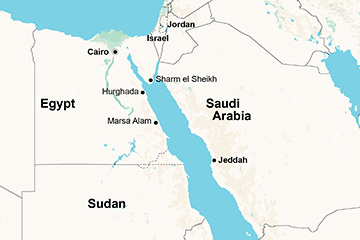 Seven cabins are on the lower deck and four are on the upper deck, where
there is also a shaded area with couches and a
small bar offering drinks. (Some Red Sea boats
maximize top deck space, which seems to make a
boat a bit top-heavy and unstable.) When I booked
through
Seven cabins are on the lower deck and four are on the upper deck, where
there is also a shaded area with couches and a
small bar offering drinks. (Some Red Sea boats
maximize top deck space, which seems to make a
boat a bit top-heavy and unstable.) When I booked
through 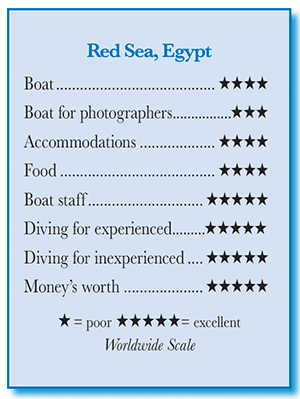 One unguided dive was on the Salem Express wreck, which sits at 100 feet and rises within 30 feet of the surface. Divers could penetrate, but we stayed outside, where we found pairs of pipefish and a handsome, beautiful nudibranch. Emperor angels were everywhere. On the propeller, a giant clam had set up house. The wreck attracted schools of silverfish, a great variety of puffers, and even a couple of sea cucumbers exercising their anal sphincters.
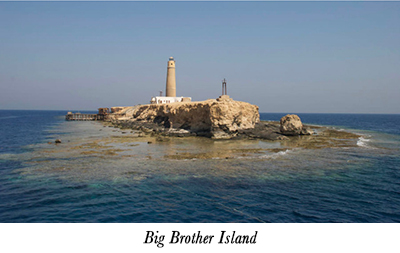 Our first dive at Big Brother, one of the few with current, was not well managed by our divemaster; we spent most of our dive fighting the current in one direction or the other, looking for elusive sharks. On the rough Zodiac rides, divers flew all over the place, some puking over the pontoons. Underwater, we passed the reef too fast to notice anything small and saw no sharks. But a second dive, toward the north side of the island, was much better. To avoid the current, we bypassed the wrecks below and spent a lot of time at 90 feet looking for sharks, but we saw none. The reef was alive with clouds of anthias, lots of pairs of butterflyfish and bannerfish, the occasional Napoleon wrasse, and high populations of triggerfish, parrotfish, and grunts.
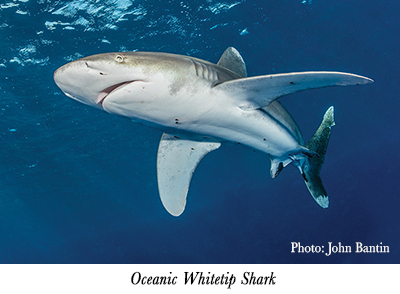
 One reason divers come to the Red Sea is to see hammerheads, oceanic white tips, reef sharks, and, if lucky, a tiger, thresher, or whale shark. The crew tried to satisfy our lust for sharks by leading us on long, slow, deep swims around known shark areas (though sightings are only common during the cold-water months). Paddling around for 45 minutes in 60-80 feet of water and staring into the blue were dull dives and a waste of time, especially since we did three in a row without a single deep shark sighting. One manta did swing by, and I followed a couple of eagle rays down to 100 feet out of sheer boredom. Despite this deep shark seeking, I sighted an oceanic white tip right above me in 10 feet of water near the end of the dive. The biggest event on one shark dive trip at Daedalus was an AH dinghy driver from the Red Sea Aggressor IV, who decided to split our two dinghies with his high-powered engines, sending a tail of wake into both our Zodiacs. Thanks, guy.
 But there were turtles. Stepping off the stern at Turtle Bay, I almost landed on one. There was silt in the water at about 30 feet, and my buddy and I dropped to 90 feet. As we shallowed up, I watched a languid giant turtle with a shell at least five feet long, scratching its belly on some rocks on the bottom. A smaller one headed for the surface a few feet away. This hard coral reef has likely been damaged by endless storms, but coral was growing back to make it vibrant and lively. I shot a few frames of slow-moving slugs: a gold-dotted flatworm, a brown-edge glossodorid, and a particularly heroic-looking pustulose wart slug.
I want to get all the stories! Tell me how I can become an Undercurrent Online Member and get online access to all the articles of Undercurrent as well as thousands of first hand reports on dive operations world-wide

| Home | Online Members Area | My Account |
Login
|
Join
|
| Travel Index |
Dive Resort & Liveaboard Reviews
|
Featured Reports
|
Recent
Issues
|
Back Issues
|
|
Dive Gear
Index
|
Health/Safety Index
|
Environment & Misc.
Index
|
Seasonal Planner
|
Blogs
|
Free Articles
|
Book Picks
|
News
|
|
Special Offers
|
RSS
|
FAQ
|
About Us
|
Contact Us
|
Links
|
3020 Bridgeway, Ste 102, Sausalito, Ca 94965
All rights reserved.