
 |

 Email Signup
|
Subscribe
|
Login
Email Signup
|
Subscribe
|
Login
For Divers since 1975 The Private, Exclusive Guide for Serious Divers Since 1975 |
"Best of the Web: scuba tips no other source dares to publish" -- Forbes |
Little Cayman Beach ResortContents of this Issue: Lembeh Resort, Sulawesi, Indonesia Parrotfish Are Essential to the Health of Coral Reefs Full-face Snorkel Masks ... Specifications Getty Has Not Requested My Images The Red Sea Sea Story Liveaboard Disaster 52 Assignments - Underwater Photography by Alex Mustard Discovered - The World's Largest Coral Never Know What You'll Find On A Leisurely Dive Editorial Office: Ben Davison Publisher and Editor Undercurrent 3020 Bridgeway, Suite 102 Sausalito, CA 94965 riding out Hurricane Rafael from the January, 2025 issue of Undercurrent
Dear Fellow Diver, As we all presumably know, climate change seriously affects the Caribbean's weather; summer storms and hurricanes seem more intense and frequent. This summer, divers in many places - Cozumel, Belize, the Caymans, and elsewhere - lost lots of diving days. While June through November is labeled hurricane season, July through October are the more likely months for that sort of weather, but that may change. If you're planning a dive trip during hurricane season, lesser storms can lead to flight delays and cancellations, and high seas and winds may mean spending days playing on your computer (or better yet, reading) in your room because your dive boat can't go out in such weather.
* * * * * It was just an early November purple blob on the weather map monitor at the Miami Airport. My dive buddy and I were on the way to Little Cayman Beach Resort for a great week of diving. It's clean and comfortable, has an amicable resort staff, superb diving, and one of the best dive operations anywhere. The food at this all-inclusive resort is legendary. It's one of my favorite places to stay and dive. After landing on Little Cayman, I got a chance to talk to divers who were departing. Uh-oh. High winds out of the north and northeast had canceled three of their dive days. That purple blob was a developing tropical depression, and warnings about canceled dives foreshadowed our weather woes for the week ahead. Our week started well on Sunday, November 3, aboard the Island Dreamer with three nice dives on the island's southwest side, led by David and Brassy. Winds from the northeast were still strong, so Bloody Bay, on the north side, was not diveable. Monday morning, as we divers gathered on the dock to board the four Newton dive boats being prepared for departure, word spread that the morning dives were on hold. After a few minutes, David, the assistant dive operations manager, shared the bad news. The blob was now projected to be a tropical storm, and they would have to suspend diving to allow resort and dive staff to prepare for the upcoming storm. Later that morning, the resort manager, Michael Ann, briefed us; the storm was projected to bring winds up to 55 miles per hour, and we would need to shelter in our rooms when the storm hit. We'd most likely lose power and internet service for a few hours. The main building has a generator backup, so food service and device charging would still be possible. Michael Ann warned us that the situation could change. The staff briefed us at mealtimes in the dining hall and gave us handouts detailing the projected storm path and the expected effects. The storm was changing, slowing down, and would bring strong winds; it could evolve into a hurricane.
While almost all of the guests were compliant with the shelter-inplace order, two guests foolishly ventured out at the height of the storm to attempt to make a video. Fortunately, no one was hurt. The powerful winds reached more than 100 miles per hour at the hurricane's peak. After the storm, I walked the grounds, relieved to see that the buildings were intact, but sand and debris were everywhere: on the walkways, in common areas, and in the pool. Two dive boats had partially sunk in the shallows. A dive boat from the Southern Cross Club was beached west of the resort. Downed power lines meant power was out island-wide. Thankfully, LCBR's extensive preparation had minimized the damage, but without power, the resort would have to be evacuated, not a small task. Only small planes can land on Little Cayman, and only during daylight hours. Cayman Air is the sole provider. Its DeHavilland Twin Otter holds about 16 people and their luggage, so it would be a two-stop evacuation. First, we guests would be shuttled to Cayman Brac, a 7-minute flight. From there, we would fly on a larger aircraft to Grand Cayman. But much to the guests' frustration, we would have to wait until Thursday. Because of conditions, Cayman Air canceled Wednesday's flights.
Thursday's evacuation went smoothly for most, with some guests delayed for hours on Brac. My buddy and I managed to get accommodations at Sunset House on Grand Cayman and did a shore dive out front to the mermaid and had a great time thanks to the air conditioning! We flew home to Michigan on Friday, a day early. Now, thinking about Rafael and my favorite diving week, I really appreciate the leadership provided by Michael Ann and her assistant, Amita, who did a great job keeping people informed about the storm. The entire staff was "all hands on deck" to complete the extensive to-do list before the storm hit and remained calm and helpful. While a few impolite guests whined and complained, they were handled professionally and honestly. Despite power and generator problems, all meals (except for the box lunch during the height of the storm) were served in the dining hall, with the usual quality. Most importantly, there were no injuries, and everybody got safely off the island and home. Despite the inconvenience, it was a job well done. Of course, this was not the trip I had planned, but there were bright spots and lessons learned. My buddy was steady in a pinch, didn't bitch, and got with the program. The family in the room next to us had three children who scrounged up brooms and shovels and cleared walkways. I carry a brick-sized phone charger when I travel and it sure paid off. My Verizon service was excellent; having connectivity and juice for my phone allowed me to connect to Cayman Air, American Airlines, and hotels on Grand Cayman. Being able to plan my way home made the week much less stressful. When embarking on a dive vacation, one always takes chances with the weather, flight arrival and departure, and whether the dive operator performs. I'll be sure to take another chance on Little Cayman Beach Resort soon, knowing I'd be well taken care of if I were there for another hurricane. E.S. Author's Bio: I completed open water training in 2005 at age 53 in a small inland lake in Michigan in 55-degree water with 2- to 3-foot visibility. My instructor assured me that diving in the cold and murky water would make me a better diver. After 19 seasons of diving local lakes and the Great Lakes, I'm not so sure, but I enjoy the cold water season here in Michigan. I take 2 to 3 trips annually to Caribbean destinations, my favorite being Bonaire, St. Croix, and Little Cayman. It's perhaps a good thing that I got certified late; if I had been a diver at age 20, I probably wouldn't have made it to dental school. PS: In 1988, I was spending a week at the Tortuga Club on Grand Cayman when Hurricane Gilbert hit; the dive ship disappeared, and the hotel was destroyed (Morritt's Tortuga Club, a condominium complex, rose from its remains). The only two guests at the hotel - a nun and I - were evacuated to a community center shelter with a couple of hundred locals; we spread blankets on the floor, pinched our noses to avoid the stench of two hundred sweating people and the clogged toilet, and got our hurricane information as it was gathered and traced on a map, then plotted with calipers. Here is my story from our November 1988 issue. -- Ben Davison www.undercurrent.org/UCnow/issues/y1988/UC1088/undercurrent198810.pdf#page=1 |


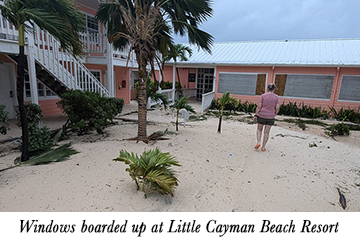 Then again, getting stuck in a hurricane is another matter, as our correspondent
writes in this month's travel story.
Then again, getting stuck in a hurricane is another matter, as our correspondent
writes in this month's travel story.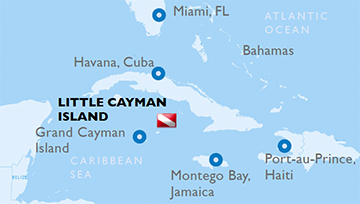 By Tuesday morning, the blob had a
name: Rafael. It was predicted to be a
hurricane by the time it hit the Cayman
Islands. Little Cayman was squarely in
its path. We bought water, soft drinks, snacks at the little store, and a small
bucket to fill with water from the pool to flush the toilet. I felt like we were
reasonably well prepared. We sequestered in our room at 3 p.m., and throughout the
afternoon and into the evening, the wind increased and became a steady roar, blowing
the rain horizontally. I opened the door a crack to look outside; the power of
the wind, rain, and blowing sand was impressive. Just before midnight, it peaked.
From my window, I could see the palm trees bending at an extreme angle. The crown
of one tree snapped off, crashing onto the walkway, startling evidence of the
storm's power. As the night wore on,
it seemed like we were not in physical
danger, and we managed to sleep
through Rafael's waning remnants. We
rode it out in our room until 8 a.m.
Wednesday, when the storm finally
began to wind down.
By Tuesday morning, the blob had a
name: Rafael. It was predicted to be a
hurricane by the time it hit the Cayman
Islands. Little Cayman was squarely in
its path. We bought water, soft drinks, snacks at the little store, and a small
bucket to fill with water from the pool to flush the toilet. I felt like we were
reasonably well prepared. We sequestered in our room at 3 p.m., and throughout the
afternoon and into the evening, the wind increased and became a steady roar, blowing
the rain horizontally. I opened the door a crack to look outside; the power of
the wind, rain, and blowing sand was impressive. Just before midnight, it peaked.
From my window, I could see the palm trees bending at an extreme angle. The crown
of one tree snapped off, crashing onto the walkway, startling evidence of the
storm's power. As the night wore on,
it seemed like we were not in physical
danger, and we managed to sleep
through Rafael's waning remnants. We
rode it out in our room until 8 a.m.
Wednesday, when the storm finally
began to wind down.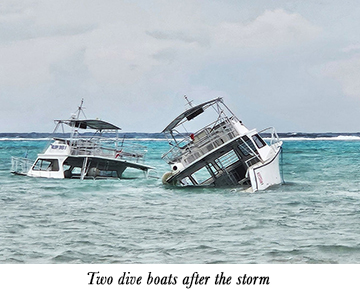 Wednesday was uncomfortable
without AC and power, but
not unbearable. Air travel to Grand Cayman and accommodations were arranged and
then rearranged as evacuation plans changed from Wednesday to Thursday. Because of
power and internet outages, some cellular services worked, others did not, complicating
departure plans. However, the front desk staff worked hard to help get
flights and accommodations on Grand Cayman.
Wednesday was uncomfortable
without AC and power, but
not unbearable. Air travel to Grand Cayman and accommodations were arranged and
then rearranged as evacuation plans changed from Wednesday to Thursday. Because of
power and internet outages, some cellular services worked, others did not, complicating
departure plans. However, the front desk staff worked hard to help get
flights and accommodations on Grand Cayman.
I want to get all the stories! Tell me how I can become an Undercurrent Online Member and get online access to all the articles of Undercurrent as well as thousands of first hand reports on dive operations world-wide

| Home | Online Members Area | My Account |
Login
|
Join
|
| Travel Index |
Dive Resort & Liveaboard Reviews
|
Featured Reports
|
Recent
Issues
|
Back Issues
|
|
Dive Gear
Index
|
Health/Safety Index
|
Environment & Misc.
Index
|
Seasonal Planner
|
Blogs
|
Free Articles
|
Book Picks
|
News
|
|
Special Offers
|
RSS
|
FAQ
|
About Us
|
Contact Us
|
Links
|
3020 Bridgeway, Ste 102, Sausalito, Ca 94965
All rights reserved.