
 |

 Email Signup
|
Subscribe
|
Login
Email Signup
|
Subscribe
|
Login
For Divers since 1975 The Private, Exclusive Guide for Serious Divers Since 1975 |
"Best of the Web: scuba tips no other source dares to publish" -- Forbes |
The Red Sea Sea Story Liveaboard DisasterContents of this Issue: Lembeh Resort, Sulawesi, Indonesia Parrotfish Are Essential to the Health of Coral Reefs Full-face Snorkel Masks ... Specifications Getty Has Not Requested My Images The Red Sea Sea Story Liveaboard Disaster 52 Assignments - Underwater Photography by Alex Mustard Discovered - The World's Largest Coral Never Know What You'll Find On A Leisurely Dive Editorial Office: Ben Davison Publisher and Editor Undercurrent 3020 Bridgeway, Suite 102 Sausalito, CA 94965 there's more to the story from the January, 2025 issue of Undercurrent
In early December, we sent you, our subscribers, an advance story on the capsizing of the liveaboard Sea Story; 11 people are either dead or missing. Since then, more of the story has unfolded, so here is the fully updated story, a serious caution about Egyptian wooden- hulled liveaboards. * * * *
The Egyptian Navy arrived on site about eight hours after they received the distress call, and, together with another passing dive boat, recovered 28 people from the water in the Wadi el-Gemal area. All were taken to a resort at Marsa Alam for medical care. The Egyptian navy warship El Fateh, aided by aircraft, continued searching for survivors. Some survivors said the vessel capsized and went under in a few minutes; others said the wreckage was floating at the surface, inverted at an angle. Rescue divers reported hearing knocking sounds coming from the wreckage, meaning people were still trapped inside after the initial rescue. Five additional survivors were miraculously rescued by divers who found them breathing from an eight-inch air pocket in a cabin inside the partly submerged hull, more than 30 hours later. From the beginning, there were knocking sounds coming from the wreckage. No one has said why the Navy did not let the would-be rescuers into the upturned vessel until the following day.
Four other bodies have been recovered. At least, seven other people including the captain remain missing presumed drowned. The divers on board included American, British, Spanish, German, Slovakian, Swiss, Belgian, Polish, Norwegian, Irish, Finnish, and Chinese nationals. Egyptian-based Dive Pro operated the Sea Story. It also operates Tillis and Coral Dream, and it operated Sea Legend, which sank with one life lost after a fire in February. Unusually Bad Weather? The Red Sea, positioned between two deserts, is infamous among mariners for its low swell but violently rough waves. It is a major route between the Indian Ocean and the Suez and has one of the world's busiest shipping lanes. Though commercial ships rarely go down in rough weather, climate change is causing storms to be stronger than ever. But Egyptian liveaboards have been beset with disasters. Fires, capsizes, and reef collisions have led to the recent demise of several different liveaboards. So, what happened to the Sea Story? We can only offer conjecture and supposition for now since Egyptian authorities continue to be evasive. The regional Red Sea governor, Major General Amr Hanafi, "ruled out that there was a technical defect to the ship and that all the required licenses had been obtained for the Sea Story." Most Egyptian-built Red Sea liveaboards have wooden hulls, which draw less water than similar steel-hulled vessels, making them less stable in a rough sea. The Sea Story was a vessel with four layers of superstructure, so it tended to roll a lot. There is no evidence it hit a reef. To provide context for the prevailing weather, the previous Friday, the Iraqi-owned freighter VSG Glory ran aground in bad weather near the Movenpick Resort, 100 miles north of Marsa Alam. It had been traveling north for a month after leaving Yemen, rarely able to make more than three knots because the weather was so bad. Two days later, on Sunday, Hurghada port authorities shut down operations due to worsening weather, predicting 16-foot waves. Yet, the Sea Story, with its divers, departed from the Port Ghalib marina. About a month before, in similar conditions, the 100-foot liveaboard MY Seaduction set sail, came to grief, and sank on October 24 with no fatalities. (Undercurrent November) A Sea Story survivor, who wishes to remain anonymous, told Undercurrent, "We all thought [at first] it was a large wave that caused the capsizing [see initial news reports]. But now we know better." The Sea Story had been towing a Zodiac, but in the harsh seas, the tow line parted. The crew boarded their second Zodiac to retrieve the first. The liveaboard hove-to at that time for a short while, a couple of hours before capsizing. Was Sea Story making a tight turn when it became 'beam on' to the wind and waves? A vessel leans when it turns and at that point is at its most vulnerable. Our informant tells us, "That was highly unlikely. It was sailing in a following sea and lost its stability on a wave crest." Most passengers were in their cabins; those who suffer mal-de-mer often go to their below-deck cabins, where they experience less motion. The crew were probably hanging on in the above decks. They were the lucky ones. Some furniture was not fixed to the floor, and would have slid to one side, giving further momentum to capsizing.
What the Experts Say Experts from The Yacht Report (formerly Superyacht News), a YouTube channel that reports on worldwide yacht incidents, point out that although the Sea Story was recently rebuilt, it had an insufficient number of life rafts, inadequate navigation equipment, and no AIS, which vessels use to avoid collisions at sea and enables tracking by third parties. (While this is mandatory for IMO-registered passenger vessels of this size, it wasn't registered with the International Maritime Organization, as are most commercial vessels.) Working from photographs of Sea Story, The Yacht Report suggested no inert gas fire-fighting equipment was in the engine room, which demonstrates a lack of safety concern. It had no radar evident. The wheelhouse appeared equipped with little more than a simple magnetic compass and a steering wheel. The low $1500 price for a 6-night trip may suggest cutting corners, not only in equipment but the quality and size of the crew. www.youtube.com/watch?v=nZxf2p6V2Oo Tony Backhurst, a well-regarded tour operator, now retired, who ran Red Sea charters, offered scathing criticism: "It's simply people not knowing their job. Why would anyone schedule a trip that needs to punch north (to Hurghada) with regularly heavy seas at that time of year? Trips don't get canceled due to bad weather because passengers need to get flights. I never ran oneway charters for that reason. They also had too many passengers packed in a poorly designed boat."
An experienced liveaboard designer and captain, Frank Van Der Linde, told Undercurrent, "I read about 16-foot waves. Why would a captain go out with a vessel [in weather] like that?" Freddy Storheil, a Norwegian Red Sea veteran operator for 18 years who sailed his steel-hulled ketch Colona II around the world twice, offered, "A boat like Sea Story should not just fall over. There was not enough ballast [for stability], I think." David Wright, another Red Sea liveaboard operator from the '80s and '90s, observed, "These [Egyptian] boats look great but are made of pine wood, lack correct calculated ballast, lack watertight bulkhead doors, and buoyancy calculations, [and have] stored oxygen onboard - so there are serious risks." And before anyone suggests that 19th-century navies sailed the world with wooden boats, I'll point out they were constructed with heavy prehistoric oak from forests that no longer exist! We may never get all the facts. Sea Story's operator, Dive Pro, in Hurghada, refused to answer inquiries from an Associated Press reporter and no longer responds to inquiries, even from the survivors. It's All About Money In the mid-'90s, the Egyptians entered the diving liveaboard market, charging half the price charged by incumbent foreign operators. Few Egyptian liveaboards, if any, are SOLAS-compliant or built to any international standards. (SOLAS sets international safety standards for life at sea.) They may meet local Egyptian regulations, but those are for vessels that operate close to shore. It's a common story of poorly trained crews, the hubris of boat captains, non-functioning smoke detectors, no emergency drills, no muster stations, and no visible fire extinguishers, and very often, in times of disaster, it's the guests themselves who initiate evacuation and rescue other guests.
Sadly, the low costs are driven by divers looking for bargains. Some operators elsewhere in the world have often told Undercurrent that safety issues never seem to matter much to most travel agents and divers booking low-cost dive trips. Low revenues in Egypt mean that back-to-back operations are essential to profitability; these vessels cannot afford cancellations and passenger refunds due to weather. But safety isn't sexy. Bargain liveaboard trips are. Alex Bryant of Emperor Divers, which has several liveaboards in Egypt and elsewhere, told Undercurrent, "The fact that the Governor of the Red Sea region had to be personally involved means that they are taking this incident, and the future of the industry, more seriously. Let's hope that continues, and we can get to a higher standard across the board." In an extraordinary intervention by the UK government, concerned about the British fatalities, the government announced, "From the evidence the British Marine Accidents Investigation Branch has obtained so far, there is cause for serious concern about the safety of some of the Egyptian dive boats operating in the Red Sea. The UK government is seeking full participation in Egyptian investigations." Perhaps, just perhaps, after a succession of disasters, this tragedy with many lost lives might finally propel the Egyptian government toward meaningful regulation and regular inspection of these liveaboards. In the meantime, Egyptian port authorities are currently enforcing the rule that liveaboards operating in the Red Sea must have two captains, one of whom must hold a Master Mariner's license, and two suitably qualified marine mechanics as part of the crew. Vessels are currently being stopped from leaving port and their dive trips canceled for lack of such qualified crews. It's a move that won't help with systemic design flaws though. This account of the sinking has been reviewed by a surviving passenger and has been checked to the best of his knowledge and belief. It has been modified slightly and added to since the Special Report formerly sent out by email. - John Bantin |


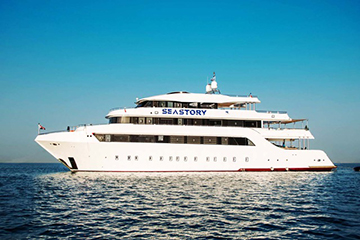 In the early hours of Monday, November 25, the
Red Sea liveaboard MY Sea Story crew issued a brief
distress call before the vessel capsized in heavy seas. An
older vessel, rebuilt and renamed in 2022, with added
decks, the 144-foot-long Egyptian liveaboard
had 18 twin cabins. It carried
30 passengers and 14-16 crew including
dive guides (crew numbers provided
vary) when it left the Port Ghalib marina
near Marsa Alam the day before. It was
due to disembark its divers in Hurghada
nearly a week later.
In the early hours of Monday, November 25, the
Red Sea liveaboard MY Sea Story crew issued a brief
distress call before the vessel capsized in heavy seas. An
older vessel, rebuilt and renamed in 2022, with added
decks, the 144-foot-long Egyptian liveaboard
had 18 twin cabins. It carried
30 passengers and 14-16 crew including
dive guides (crew numbers provided
vary) when it left the Port Ghalib marina
near Marsa Alam the day before. It was
due to disembark its divers in Hurghada
nearly a week later.
I want to get all the stories! Tell me how I can become an Undercurrent Online Member and get online access to all the articles of Undercurrent as well as thousands of first hand reports on dive operations world-wide

| Home | Online Members Area | My Account |
Login
|
Join
|
| Travel Index |
Dive Resort & Liveaboard Reviews
|
Featured Reports
|
Recent
Issues
|
Back Issues
|
|
Dive Gear
Index
|
Health/Safety Index
|
Environment & Misc.
Index
|
Seasonal Planner
|
Blogs
|
Free Articles
|
Book Picks
|
News
|
|
Special Offers
|
RSS
|
FAQ
|
About Us
|
Contact Us
|
Links
|
3020 Bridgeway, Ste 102, Sausalito, Ca 94965
All rights reserved.