
 |

 Email Signup
|
Subscribe
|
Login
Email Signup
|
Subscribe
|
Login
For Divers since 1975 The Private, Exclusive Guide for Serious Divers Since 1975 |
"Best of the Web: scuba tips no other source dares to publish" -- Forbes |
Damai II, Raja Ampat, IndonesiaContents of this Issue: Misool Resort, Raja Ampat, Indonesia Your Travel Experiences are Important to Other Subscribers As Animals Confront Us, We Must Blame Ourselves Damai II, Raja Ampat, Indonesia What’s Going on in Chuuk Lagoon? Punishment Abroad for Training Deaths Whatever Happened to Dive Knives? Our Recommendations Insurance and the Traveling Diver: Part II Free Diver Pipin Sues Netflix for Defamation Lend A Hand on Your Next Dive Vacation: Part I Editorial Office: Ben Davison Publisher and Editor Undercurrent 3020 Bridgeway, Suite 102 Sausalito, CA 94965 from the April, 2023 issue of Undercurrent
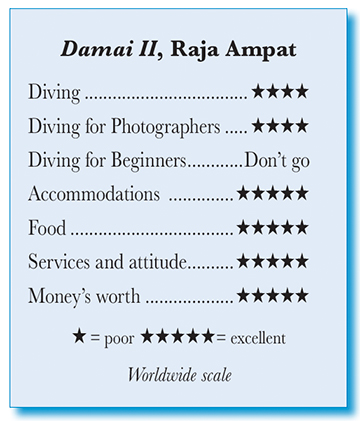
Raja Ampat seemed to offer the best diving on the planet, so I've been eager to visit for some time. At last, I selected an itinerary aboard the Damai II, sponsored by Blue Water Dive Travel, which covered a swath from the central islands to the northern ones and then to the southern islands. Along the way, I learned that the best diving on the planet does not mean every coral, fish, and critter rolled into one, day in and day out.
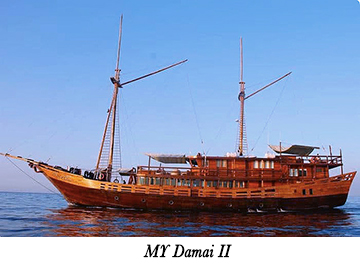
When I arrived at the hot and humid Sarong airport at 6:30 a.m., I was met by Mika Hollnbuchner, an Austrian, formerly an IT professional and now the cruise director of the Damai II. After a quick drive to the harbor and a short haul on the dive skiff, I climbed aboard the striking, ironwood craft with shiny teak decks. Built in 2011, she's a 40-meter diesel-powered craft, showing just a bit of wear, that accommodates 12 divers in 7 cabins with a crew of 20. My spacious air-conditioned cabin had a double bed pushed up against the bulkhead, giving me plenty of room. The ceiling had been taped in a few spots to prevent water from dripping on the bed, which it did, but overall the room was comfortable, and the large bathroom shower had plenty of hot water and a bench to sit on. The boat is a photographer's dream, so Blue Water Dive Travel uses it for photography workshops, and this one was led by photojournalist Mark Hatter. He instructed us on shooting techniques and post-production using Lightroom. We were an eclectic group of photographers, ranging from those shooting with housed iPhones to professional-level photographers using DSLRs with elaborate light configurations. Mainly Americans, we were joined by a German, an Austrian, and a UK ex-pat living in Singapore. All were good divers, and most were avid photographers. On the dive deck, each gear station had a camera rinse tank next to the seat where the tank/BCD is stowed. An air hose was readily available to blow off the cameras. The staff carefully loaded our cameras onto the skiffs, unloaded them after the dives, gently rinsed and blow-dried them, and placed them at each diver's spot in the camera room, which had 11 stations with 120-volt and 220-volt outlets. Even the dining room table has power outlets underneath so guests could plug in between dives -- and maybe during meals, as some did. But there was one odd problem. During the evenings, we presented our best images or video clips to receive feedback from Mark and the group on composition and color grading. However, the salon had an outdated screen projector, so we didn't have the clarity and resolution of HD TV monitors, quite a shortcoming for this upscale craft. With few exceptions, visibility wasn't good for fish photographers; often, a school of fish 20 feet away was hardly visible. My video lights illuminated the clouds of nutrients in the water, obscuring whatever I was trying to shoot. In this kind of water, macro shooting is the way to go. When visibility improved, I marveled at large schools of jacks, sweetlips, and snappers, turtles here and there, and I saw a few sizable, well-camouflaged wobbegong sharks lolling on the bottom. On one dive with excellent visibility, we were diving a sea mount with swarms of fish, even baitballs, and my camera failed. Initially I was upset, but after relaxing and diving as a tourist rather than a photographer, I appreciated the sea life more than I would have had I been fiddling with my camera.
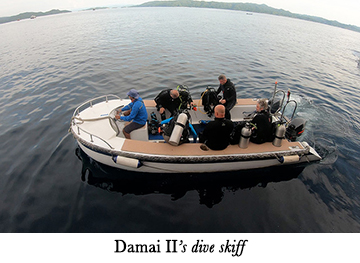
Our daily routine was a light breakfast from 5:30 to 7 a.m., a dive, a hot breakfast from 8 to 8:30 a.m., a 10:30 a.m. dive, lunch, a third dive around 3 p.m.; then the night dive -- really a twilight dive -- around 6:30 p.m. Dinners were after the night dive, though divers who skipped the night dive could have dinner earlier. With only two dives offered on a long transit day, we totaled 30 over eight days. Between dives, I hung out on the large main deck salon or the bridge deck and sometimes headed to my cabin for an afternoon nap. The ship's captain, assistant captain, engineer, and deckhands kept us moving and assisted divers when loading/offloading from the skiffs, toting gear, or getting in and out of wetsuits. They rinsed, hung, folded, and placed our wetsuits at each diver's station before the next dive. We all wore cover -- I wore a 5 mil and a hood -- though the water was around 86 F. I wanted protection from the scores of jellyfish on many dives -- the first day, a diver got badly stung on a hand and leg. They divided us into three groups of four, in two skiffs, with the guides rotating between groups. The guides gave excellent briefings and artistic descriptions of each site. Two local guides, Yanto and Rian, had a knack for finding the unique. All the macro lovers wanted to join Rian because he discovered the tiniest critters, including several pygmy seahorses smaller than a fingernail. The third guide didn't lead us according to the dive briefings and didn't point out much, so with him, I was more inclined to dive on my own, venturing from the group to search for unusual creatures. We generally surfaced at the same time since everyone was a slow breather and a good diver.
My dive team included a California doctor and a couple from Ohio. The current was strong, the water murky. It was a challenge to keep an eye on my buddies. The other boat's team caught up to us, flew by, then hooked up, and the Doc joined them while the three of us and our guide continued flying through the low-viz channel. Ten feet away, my buddies were only silhouettes. I didn't spot any fish, and nothing interesting on the bottom. After five minutes, the four of us (our doc buddy had been hurled down the current alone, eventually surfaced, and was picked up) ended in a side pool jostled about by an eddy. We kicked to the center of the channel and floated with the current. The skiff soon arrived. The groups reconnected, and some of us decided to repeat the dive but stay closer to the shore and mangroves (I still had 1800 psi). This time, skirting the walls was much more enjoyable -- the viz wasn't much better, but there was plenty to see. Near the end, we slipped back into the serious current, and I nearly bulldozed a dead tree on the bottom. Current rides are thrilling, though at times unnerving in low visibility. In case I got in trouble on any dive, I always carried a Nautilus Marine Rescue GPS, which enabled me to send my location to the Damai II. I can program it with any liveaboard's MMSI number and send a "Man Overboard" distress signal to that craft for 30 minutes; if I don't turn it off after 30 minutes, the Nautilus would then broadcast my location to all vessels within range. (You can read more about this in the May 2020 issue of Undercurrent.)
A typical lunch included a salad starter, then pork schnitzel. One day it was coleslaw salad, then burgers and fries. One dinner opened with cauliflower soup followed by sirloin steak or grilled eggplant and capped off by crème brulee. Another night, it was onion soup, followed by grilled pork ribs and cheesecake. Vegetarians received superb substitutes. One morning, smoke from the toaster set off the dining room fire alarm. I didn't hear other alarms blaring because they were not connected to each other. A single upper deck smoke alarm may not be heard below decks. The primary escape route from my cabin was quick, but if forced to take the alternate route, I'd have to pass through two other cabins, which would be tricky in an emergency, since it was blocked when I tested it. Mika said he is searching for an integrated alarm system. But there were no emergencies and no drama on this trip, uncommon when a boatload of strangers are locked up together for a week. The only "moments" I had were with a diver on my team who seemed a little clueless on photography dive etiquette (i.e., bumping into me or getting in front of me while I was filming), so I just stayed away from him (there's always one onboard). Otherwise, it was a boatload of great divers, great people, and an exceptional crew that made everything run well and on time. But none of us could control the one thing that bothered us all: the gobs of trash floating on the surface, at times so much that the skiffs traveled cautiously to avoid it. In one area, thousands of capped plastic water bottles floated in a debris field more than a mile long. At another anchorage, mounds of trash piled up against the hull. It all comes from land, and some say the primary culprits are the nearby growing settlements of Sorong and Wasai. Still, the ocean currents originate in the Philippines, which dumps more trash into the ocean than any other nation. The region has no waste management plan, so it's an unfolding tragedy. Overall, I think my expectations were too high, for I did not see stunning corals like Fiji, the wild fish action of Blue Corner in Palau, or the many pelagics of Socorro or French Polynesia. And I did not have the gin-clear water I expected. But indeed, there was beautiful coral, endless fish, and unique creatures. Of course, no two trips are alike; conditions are never the same, and sites always differ. I'll return, maybe take a different itinerary at another time of year, but surely aboard the Damai II. I'm looking forward to seeing what I missed. -- V.A. Author's Bio: I've been certified for 35 years, and since retirement, I've ramped up the frequency of traveling to new places. I dive and hike all over the world, with a passion for capturing those moments in pictures and videos and sharing my experiences with others. Hiker, diver, adventurer, amateur photographer, that's me. Divers Compass: I had a single cabin at US$9,250. It's around $7200/pp for a standard shared cabin . . . . Aluminum 80s were filled to 2900 psi; 100 cu. ft. tanks were available . . . Several divers rented gear because of strict airline weight restrictions . . . . Some crew members were massage therapists, offering free hour massages daily, indeed a luxury . . . . No charge for beer or soft drinks; a glass of wine comes with dinner; refills or bottles are extra . . . . Before departing, get informed on Indonesian COVID protocols . . . . Travelers from most countries must obtain a 30-day visa; pay before departing at https://molina.imigrasi.go.id/ . . . . At Jakarta, I whizzed through immigration while others waited in long lines. . . . Batik Airlines tried to charge one diver hundreds of dollars for excess weight, which he negotiated down to $200. I purchased an extra weight allowance on the airline website for $120. www.dive-damai.com |


 On my third day out, I did have that near-perfect diving. After we anchored
near Sauwandarek Village jetty in Pulau Mansuar, I descended past several two- to
three-foot barracuda, then kicked along a stunning healthy coral garden, meeting
up with a large green sea turtle. She didn't mind my intrusion, but an inconsiderate
photographer stuck his camera in her face . . . . goodbye turtle. I kicked up
to the old pier where hundreds of sergeant majors darted about. In deeper water,
a massive school of yellow-tailed fusiliers intermingled with a great school of
jacks to become an enormous wall of fish so thick I couldn't tell if a diver was
behind them. I hung out for eight minutes watching the show. Would it all be like
this?
On my third day out, I did have that near-perfect diving. After we anchored
near Sauwandarek Village jetty in Pulau Mansuar, I descended past several two- to
three-foot barracuda, then kicked along a stunning healthy coral garden, meeting
up with a large green sea turtle. She didn't mind my intrusion, but an inconsiderate
photographer stuck his camera in her face . . . . goodbye turtle. I kicked up
to the old pier where hundreds of sergeant majors darted about. In deeper water,
a massive school of yellow-tailed fusiliers intermingled with a great school of
jacks to become an enormous wall of fish so thick I couldn't tell if a diver was
behind them. I hung out for eight minutes watching the show. Would it all be like
this?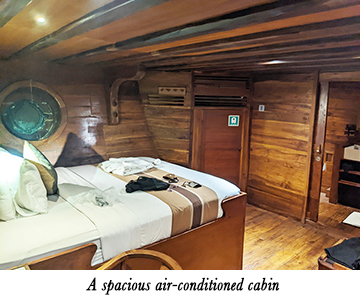 The night dive at Tapokreng along a sandy slope was perfect for spotting little critters, like seahorses, two tiny crabs that appeared to be mating, and scores of colorful, radiant sea urchins (think of Tribbles from Star Trek, but spiny, not furry). I was filming a tiny cuttlefish when suddenly it bounced up and crashed a couple of inches away. When I reviewed my video, I saw that a tiny fish had swooped past him in a blur and stolen his prey. He recovered quickly and gobbled up another little critter illuminated by my lights. Later I was carefully filming a small octopus whose head was not much larger than a thimble when I felt a sharp needle-like pain in my knee. I swore through my regulator when I realized I had inadvertently brushed a sea urchin. Back on the boat, I spent several minutes digging into my flesh with a sewing needle to extract the spine tip.
 The Passage, a tiny channel between Waigeo and Gam islands, is a dive with a raging current where divers "fly" from one end of the channel to the other, theoretically with lots of fish over great corals. As the skiff made its way through the beautiful channel, we were flanked by mangroves and rainforest; the water churned in spots as if we were riding on a fast-moving river. The plan was to drop in, ride the current for 30 minutes, and for me, film anything that looked interesting, a challenging task in a current.
 Meals were excellent, with the kitchen accommodating all requests. We could
select one of the planned meals or ask for something
else, quite unusual on a liveaboard. I discovered
Mie Goreng, a traditional Indonesian noodle
and veggies dish; it wouldn't be right without a
teaspoon or more of sambal, their daily-made hot
chili sauce that packed a punch! After one guest
over-spiced his entree, sweat poured from his forehead
for the rest of the meal.
Meals were excellent, with the kitchen accommodating all requests. We could
select one of the planned meals or ask for something
else, quite unusual on a liveaboard. I discovered
Mie Goreng, a traditional Indonesian noodle
and veggies dish; it wouldn't be right without a
teaspoon or more of sambal, their daily-made hot
chili sauce that packed a punch! After one guest
over-spiced his entree, sweat poured from his forehead
for the rest of the meal.
I want to get all the stories! Tell me how I can become an Undercurrent Online Member and get online access to all the articles of Undercurrent as well as thousands of first hand reports on dive operations world-wide

| Home | Online Members Area | My Account |
Login
|
Join
|
| Travel Index |
Dive Resort & Liveaboard Reviews
|
Featured Reports
|
Recent
Issues
|
Back Issues
|
|
Dive Gear
Index
|
Health/Safety Index
|
Environment & Misc.
Index
|
Seasonal Planner
|
Blogs
|
Free Articles
|
Book Picks
|
News
|
|
Special Offers
|
RSS
|
FAQ
|
About Us
|
Contact Us
|
Links
|
3020 Bridgeway, Ste 102, Sausalito, Ca 94965
All rights reserved.