
 |

 Email Signup
|
Subscribe
|
Login
Email Signup
|
Subscribe
|
Login
For Divers since 1975 The Private, Exclusive Guide for Serious Divers Since 1975 |
"Best of the Web: scuba tips no other source dares to publish" -- Forbes |
Misool Resort, Raja Ampat, IndonesiaContents of this Issue: Misool Resort, Raja Ampat, Indonesia Your Travel Experiences are Important to Other Subscribers As Animals Confront Us, We Must Blame Ourselves Damai II, Raja Ampat, Indonesia What’s Going on in Chuuk Lagoon? Punishment Abroad for Training Deaths Whatever Happened to Dive Knives? Our Recommendations Insurance and the Traveling Diver: Part II Free Diver Pipin Sues Netflix for Defamation Lend A Hand on Your Next Dive Vacation: Part I Editorial Office: Ben Davison Publisher and Editor Undercurrent 3020 Bridgeway, Suite 102 Sausalito, CA 94965 from the April, 2023 issue of Undercurrent
Dear Fellow Diver, When divers talk about the world's best diving, Raja Ampat in Indonesia is often the topic. After all, this area off West Papua -- home to 1500 islands, cayes, and shoals -- contains more hard coral and fish species than in any other region -- 550 hard coral species and 1400 fish species. If there is any destination on your diver's bucket list, this should be it. If you're a North American, it's a long way from home: two full days, plus or minus, to get there, and the same for returning home. Travelers from the East Coast often fly to Jakarta through Dubai or Istanbul, while from the West Coast, Seoul and Singapore are common non-stop options. From Jakarta, it's another two-hour flight. Most itineraries require an overnight somewhere in a hotel; even then, you'll arrive jet-lagged and out of sorts. So, at least 10-14 days at your destination makes sense, as does having a good travel agent to put it all together for you. Whether you stay on land or hunker down on a liveaboard, you'll have differing dive experiences. In this issue, we'll feature both a liveaboard -- the Damai II -- and a resort, Misool Resort, as well as an article by our senior editor, John Bantin, who has dived the area four times, spending many weeks there. Misool Resort
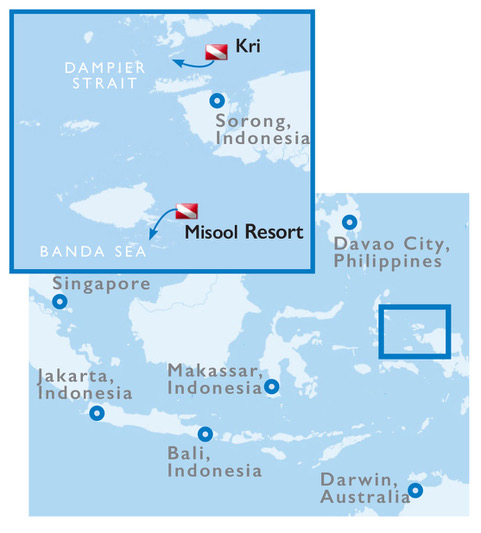
Noted marine biologist Dr. Robert Erdmann (author of 214 scientific articles and science adviser for films by BBC and NatGeo) wrote about Misool: "There is greater diversity . . . . a larger number and greater diversity of fish, coral, and mollusks . . . . on these reefs than anywhere on earth. A single football field-sized patch of Misool's reefs has nearly five times the number of coral species as the entire Caribbean Sea." And that means emperor angelfish, wobbegong sharks, fusiliers in massive schools, pygmy seahorses at a shallow 30 feet, black tip sharks, bumphead parrot fish, and manta rays so prevalent that all 20 divers sighted them in my group. Some days at dusk, I joined boat dives to see fast-moving flasher wrasse as well as brilliantly colored mandarin fish. Though Misool is one of the world's more incredible places for scuba diving, there aren't many divers, mainly because "you can't get there from here," and if you do, you've spent a bundle. As Ben's introduction indicated, it's at least a two-day journey for North Americans. And a complicated one. After arriving in Jakarta, I got a hotel room for several hours, then flew to Sarong at half past midnight. Feeling like a bleary-eyed, walking zombie, I arrived around 6 a.m. (a four-hour flight, a two-hour time change) and waited until 8 a.m. to take the boat for a four-and-a-half-hour journey to Misool Resort. Thankfully, it was a comfortable boat with cushioned seating, an outdoor area, coffee, soft drinks, and snacks. Sixty hours after leaving home, I landed at the Misool dock. In 1969, it took Buzz Aldrin 76 hours to travel from Florida to land on the moon.
The smiling and helpful dive staff carried the tanks to the boats, set up gear, and checked the nitrox levels. On my first day, I asked a leader his name. "Bram," he said. Being the clever fellow I am, I told him that Bram Stoker was the author of Dracula. In a well-rehearsed schtick, his colleague Van responded, "never night dive with Bram because he'll suck your blood!" I suppose they hear that weekly. I dived three single-tank boat dives daily, at 8 a.m., 11 a.m., and 3 p.m., and an occasional dusk dive. From alongside the dock, the six stable 23-foot covered aluminum speed boats reach most sites in under 10-15 minutes. Though small, the boats are crewed by a driver, deckhand, and two dive leaders for the eight divers aboard. One of those nearby sites is Boo Windows, with two swim-thrus. Down below, as I marveled at the large, healthy plate coral, a fellow diver pointed beneath one plate, where a unique wobbegong shark had settled in, accompanied by a couple of sweet lips. I cruised among immense, pristine barrel sponges, marveling at the large gathering of fusiliers and baitfish. In a crevice, a hairy squat lobster kept a careful eye on me. Because the current was strong, I had to use my reef hook to stop and look, being careful where I hooked to avoid snagging live coral. And one had to be careful not to get scraped. I wore a 1 mm wetsuit to protect me on those few occasions when the currents swept me into some hard coral.
We were free to dive as we wished, with no restrictions on time or depth, so the leaders' jobs were to keep an eye on us as best they could rather than point out things; however, when planning a dive, they tried to meet a group's requests for seeing such things as manta rays or dense schools of fish. After each dive, they performed a careful headcount. Understandably, there were no night boat dives. The founders of the Misool Resort established and now fund the Misool Foundation, a charity that supports an 18-person, 3-boat ranger team that constantly patrols the area to enforce the no-take policy to keep the marine sanctuary pristine. That sustainable, eco-friendly ethos seeps into the kitchen, and from my pre-trip reading, I learned about such things as "Meatless Monday." As one who considers a Big Mac an appetizer, I was worried that the food would be hippie stuff -- like tofu and sprouts -- accompanied by green tea. But I was stuck in the past. The meatless meals were delicious, and one could always go off the day's menu and get chicken, meat, or even pizza (but no pork; Indonesia is the world's largest Muslim country). Or go vegetarian or vegan. For example, one night's dinner menu offered two entrees: slow-cooked curry with beef or slow-cooked curry with jackfruit and tofu. I went for the curried beef, but both were excellent and served by a skilled wait staff. The pastry chef, Yuna, baked sinfully delicious desserts as well as all the bread, rolls, and muffins. The Indonesian beer, Bintang, is quite good, and there were some Balinese wines, which were, well, only just drinkable.
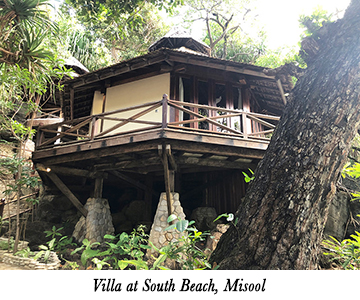
For me, it was a long walk to breakfast. I stayed in the South Beach section, which is less expensive because it is a good 15-minute walk, which includedup and down 220 narrow, steep,and winding steps. It is a goodworkout but a sweaty slog in thehumid, equatorial weather. Itcan be too much to return to itbetween dives, but South Beachvillas each have a two-way radioto summon the taxi, a small runabout that lands on the beach andzips you to the dive center dock.It doesn't run during low tide, soyou'll inevitably do some walking. The dive center has several dunk tanks, warm water showers, bathrooms, and a place to hang wetsuits. Inside, each villa has an assigned area to stow gear, wall pegs, and a cubby. Next door in the camera room, cooled by ceiling fans, are a dozen camera stations. On the second floor of the dive center is the hive, a large room with tables and chairs, comfortable couches, and a few ceiling fans, where photographers set up their laptops and share images or relax on the deck. Only here will you find WIFI -- and weak, at that; messages or e-mails sent usually got through, but sometimes very slowly. Forget net surfing or phone calls. Next door in the camera room are a dozen camera stations. The resort also runs a 36-foot catamaran with a canvas top that holds a dozen divers easily. It travels about 90 minutes daily for a two-tank dive at sites such as Tank Rock, Nudi Rock, and Whale Rock. The Nudi Rock dive site is named for the two trees sprouting from this tiny rock that look, at least to those with vivid imaginations, like the rhinophores on a nudibranch. The Brits describe this site, as they do many Misool sites, as "currenty," and indeed, there are often strong currents. But the upside is that schools of fish thrive in the currents, which are nourishing the hard and soft corals. Here I saw a school of a dozen barracuda, stacked like logs, trevally, gray reef sharks, and a manta cleaning station. Two mantas swam in, swooped up for a 360-degree turn, then returned. The rule here is to remain stationary and let them come in on their own. After the dive, I handed up my gear, climbed the ladder, and headed for snacks and drinks before the second dive. I did have one concern about diving from the small boats. Most leaders counted 1-2-3, and together we wouldall roll in. But, some didnot count, so we enteredwhen ready, which I thoughtrisky. The strong current could quickly move a diver in the water, directly under another diver rolling back; his tank could crunch thehead of the diver below. Ifa leader did not count off,I'd ask a crew member if itwas clear behind me.
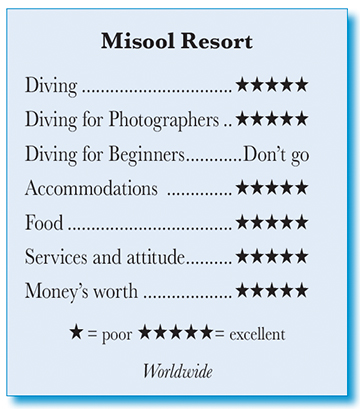
My week at the beautiful Misool Resort was hassle-free, thanks to a professional, well-trained staff that worked hard to make that happen. For guests, it was necessary to maintain a sense of humor because, for many, the lengthy, multi-modal travel seriously disrupted sleep patterns. We seemed to have a silent agreement that we'd all grin and bear it. My only complaint would be the mosquitoes (they're out at dusk and dawn), but the mosquito netting over my four poster canopy bed kept them away at night. The housekeeping staff neatly rolled up the netting in the morning and lowered it before I returned from dinner. My air conditioner over the bed made sleeping comfortable. Considering the energy-conscious, pristine environment, I never ran it during the day. The resort closes from July through September when the seas get rough. Mark Atkinson leaves then to pursue his passion, power gliding, where he jumps off cliffs with a parachute and a small engine with a propeller strapped to his back. And I thought current diving was challenging. Clearly, Raja Ampat is for advanced divers only. Although the resort has a nurse on staff, the nearest doctor is in Sorong, and then it's a two-hour ferry ride to the nearest chamber. With the strong currents and diving freedom, one must be a cautious diver skilled in buoyancy control. If you are, you'll relish the extraordinary diving offered by this beautiful, top-of-the-line resort. --G.P.T. Our undercover diver's bio: Certified in 1983, I am a PADI Advanced Open Water diver with more than 1,000 dives from resorts and liveaboards in the Caribbean, Indonesia, Philippines, Maldives, Red Sea, Mexico, Florida, California, and Hawaii. Diver's Compass: Depending upon your cottage or villa location, a seven-night stay ranges from $3,370 to $4,045/person; add 40% for single occupancy; they also offer 9- and 12-day packages, more suitable for all the travel involved . . . . The price includes all meals, three daily boat dives, unlimited shore diving, nitrox, and a night's hotel stay in Sarong before boarding the flight back to Jakarta . . . . To run the credit card machine during check-out, the resort turns off the WIFI . . . . They offer snorkeling trips; stand-up paddle boards; sea kayaks; diver propulsion vehicles; and hikes on nearby islands . . . . Rental gear, including 1 mm wetsuits and skins, is top-notch, but there is no equipment repair . . . . The 80 cu. ft. aluminum tanks were always filled to 3000 PSI . . . . Round-trip boat transfer from Sorong is $380 pp . . . In Jakarta, I stayed at the FM7 Hotel, which was clean and adequate. www.misool.info. |


 After my first backward roll into the waters of Misool, I was awed by the huge sea fans up to six feet high and wide. So abundant were the colorful sponges and soft corals, I felt like I was in an over-stocked flower shop. The schooling fish extended as far as the eye could see, which is rather far in the 50- to 75-foot visibility, in toasty 85-degree water.
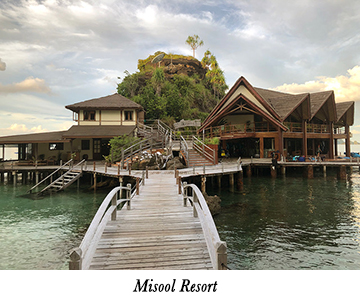
 The spectacular Misool Resort is on a small private island in remote Southern Raja Ampat. Mark Atkinson, a charming New Zealander, competently manages his staff of 80. Crafted from recycled tropical woods, the lovely dining room opens on three sides to the lagoon. A two-minute walk takes you to the dive center and camera room. Its 19 cottages and villas, either over the water or on steep slopes, hold 40 guests. All have ocean views and are furnished with a queen-sized bed, stylish chairs, and a bathroom with a warm shower (towels are not limitless -- the resort makes its own fresh water). The over-the-water villas have a deck with two chaise lounges for enjoying the sunset. My villa had an electric tea kettle, teapot, and French press, with tea bags and ground coffee. Most guests were American or British, along with a few other nationalities, and a staff-to-guest ratio of 4 to 1.
 On almost every dive, the currents
were strong. While diving from
the 23-foot boats, we usually entered
the water simultaneously, diving up
to 75 feet deep and never surfacing as a group because the currents moved us quite
a distance apart. Indeed, it was even hard to stay with my buddy, so carrying a
signal marker buoy (SMB) was mandatory. On one dive, our leader had to blow his
whistle to summon the boat from the other side of a rock island because the captain
couldn't see us. I was glad I had my long-ignored whistle on my BCD.
On almost every dive, the currents
were strong. While diving from
the 23-foot boats, we usually entered
the water simultaneously, diving up
to 75 feet deep and never surfacing as a group because the currents moved us quite
a distance apart. Indeed, it was even hard to stay with my buddy, so carrying a
signal marker buoy (SMB) was mandatory. On one dive, our leader had to blow his
whistle to summon the boat from the other side of a rock island because the captain
couldn't see us. I was glad I had my long-ignored whistle on my BCD.
 The dining room opened at 6:30 with a buffet of fruit, cereal, muffins, and
toast. After the 8 a.m. dive, there was a full breakfast about 9:30, with eggs,
pancakes, French toast, and oatmeal. One morning with my eggs, I ordered beef
bacon, which was barely OK compared to the real stuff.
The dining room opened at 6:30 with a buffet of fruit, cereal, muffins, and
toast. After the 8 a.m. dive, there was a full breakfast about 9:30, with eggs,
pancakes, French toast, and oatmeal. One morning with my eggs, I ordered beef
bacon, which was barely OK compared to the real stuff.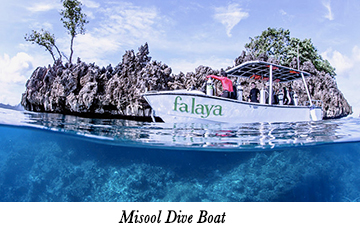 One fine dive spot with no current was the shallow lagoon opposite the house reef. In the 50-foot visibility, I spotted many fascinating creatures, including shark pups swimming in the shallows. One morning walking to the dive center, I noticed two octopuses mating. It's an excellent spot for split-level shots to capture the shore and critters below.
I want to get all the stories! Tell me how I can become an Undercurrent Online Member and get online access to all the articles of Undercurrent as well as thousands of first hand reports on dive operations world-wide

| Home | Online Members Area | My Account |
Login
|
Join
|
| Travel Index |
Dive Resort & Liveaboard Reviews
|
Featured Reports
|
Recent
Issues
|
Back Issues
|
|
Dive Gear
Index
|
Health/Safety Index
|
Environment & Misc.
Index
|
Seasonal Planner
|
Blogs
|
Free Articles
|
Book Picks
|
News
|
|
Special Offers
|
RSS
|
FAQ
|
About Us
|
Contact Us
|
Links
|
3020 Bridgeway, Ste 102, Sausalito, Ca 94965
All rights reserved.