
 |

 Email Signup
|
Subscribe
|
Login
Email Signup
|
Subscribe
|
Login
For Divers since 1975 The Private, Exclusive Guide for Serious Divers Since 1975 |
"Best of the Web: scuba tips no other source dares to publish" -- Forbes |
Tiger Beach, Grand Bahama IslandContents of this Issue: Tiger Beach, Grand Bahama Island Tiger Beach Dives Can Go Wrong Chest Compressions Can Save a Diver's Life Emperor Explorer, The Maldive Islands The Risks of Diving in Remote Places The Value of Using a Dive Travel Agent The Shark Whisperer on Netflix Take Clive Cussler on Your Deco Stop Orcas Have Been Trying to Feed People Editorial Office: Ben Davison Publisher and Editor Undercurrent 3020 Bridgeway, Suite 102 Sausalito, CA 94965 drenched with adrenaline from the July, 2025 issue of Undercurrent
Dear Fellow Diver, One of the first directions in our detailed dive briefing was "Don't pet the sharks." Are they kidding? I'd never been, nor wanted to be, close enough to a shark to pet it, but at Tiger Beach, I was often close enough to pet these massive creatures -- in fact, really close to these apex predators. But as instructed, we never petted them. Being within petting distance meant I was also within easy chomping distance of a dozen or so 14-foot, half-ton tiger sharks. I could feel my heart racing, and I was breathing much harder than I usually would at 30 feet, which is why they told us to check our SPGs often. At our dive briefing, we were told that sharks are attracted to shiny objects, so we removed them from our kit and also wore black hoods and black gloves. These no-shine efforts were not a problem but they raised my anxiety level about diving with tigers. We were told to look sharks in the eye and show no fear, which meant, for example, don't fumble nervously if you drop your camera. Just calmly pick it up. Looking these 14-foot tigers in the eye and not showing fear took a great deal of effort because on my first dive with them I was seriously frightened, and I'm positive that every other first-time Tiger Beach diver was equally frightened. But the saving grace was that the shark feeders really know the sharks well, and 15 minutes into my first dive, I saw that the sharks were moving in a fairly predictable pattern. Indeed, the shark feeders often petted their snouts, and sometimes they even opened a shark's mouth to give it bait.
After the first dive, I asked myself, "Why am I putting myself in a position where I need to manage my real fear that the sharks can inflict serious injury?" I'm sure each diver has their own answer to this question, but for me it goes like this: I've been diving for decades and have seen sharks many times in the open ocean as well as on baited dives. They're magnificent creatures that inspire a mix of fear and awe. Being right next to huge tiger sharks was truly exhilarating, and it forced me to conquer my fear, which resulted in a uniquely satisfying experience that gave me a great sense of accomplishment. Tigers run 10-14 feet in length and weigh between 850 and 1,400 pounds, with the occasional outlier being even longer and heavier. We saw at least one tiger on every dive and sometimes as many as four. Often, a six-foot lemon shark with an unnerving toothy grin came to the bait box. A couple of times, the leader took out a scrub brush and rubbed the lemon's head, which it seemed to enjoy. The lemon often parked itself on the sand within 10-15 feet of the divers, but it was never aggressive and I became comfortable around it. Once, a photographer moved three feet from its mouth for a close-up. Caribbean reef sharks, aggressive eaters, were not fed from the box because they might chomp on a feeder's hand. There were always three or four reef sharks around and it looked to me that they followed the tigers to pick up scraps.
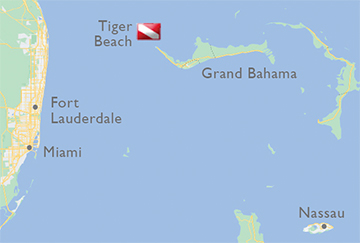
The combination of over-weighting and strong currents made it nearly impossible to swim. So, we were instructed to stand with our backs to the current and shuffle along backward, a very awkward task On my first dive, under-weighted, I had trouble standing in the powerful current. So I shuffled along the bottom on my knees, keeping one hand on the sand. When I became more comfortable, I pushed myself into a full kneeling position, leaned back into the current, and stayed upright. Diving so shallow meant that a safety stop wasn't needed, which was a good thing because three or four lemon sharks often circled us as we entered or exited the water. These 4-foot sharks posed no threat, we were told, but it was still a bit unnerving to be circled by them. To ascend, they instructed us to add air to our BCDs, which is contrary to the standard of emptying your BCD before ascending to avoid shooting to the surface. The boat crew had dropped a weighted down-line, so I shuffled over and grasped it, then inflated my BCD. At times, the strong current pulled the line and me 10-15 feet from the ladder. Overweighted, it was a tough slog to the ladder while fighting the current by finning and pulling myself hand-over-hand on the line. Our highly experienced local boat captain, Dave, who's in terrific shape, closely watched us, and pulled in the line to help get us to the boat. As I became more comfortable, I shuffled past the down line, added air to my BCD and let the current carry me up the line to the ladder. Carrying so much lead, it was difficult to climb the ladder. The visibility in the clear blue water of the Bahamas was routinely 75-100 feet, but there was hardly any marine life beyond the sharks. The dive sites were sand and more sand, with sea grass on one site and a tiny reef on another. You see, Tiger Beach is not a beach. It's in the open ocean, out of sight of Grand Bahama Island. Local legend has it that it was discovered by Scott Smith, who operates dolphin-sighting trips on his liveaboard, Dolphin Dreams. When Florida-based dive operator Jim Abernethy saw the area, he named it Tiger Beach, hoping the name would camouflage its location. It's a long, rough journey from Grand Bahama, and while it didn't happen on my trip, sometimes it's too rough for the boat to go out, and you'll be stuck ashore.
Before the first dive, Vinny gave a well-prepared safety briefing supplemented by a PowerPoint presentation emphasizing safety first, and that divers must understand the feeding process. To bring in the sharks, they chum the water before the divers enter. Then Vinny and/or Deb descend with the 18-inch square aluminum bait box, which has holes in the sides. They place the box on the sand and kneel behind it with their backs to the current. The current carried the scent of the bait into the blue, and the sharks soon appeared, swimming against the current to the bait box. After passing the bait box, the sharks continued for a few yards and then turned 180 degrees to make another pass at the box. To keep them interested, every few passes they're handed a piece of fish. We divers sat or kneeled behind the plane of the bait box to the right and left of the feeder, out of the current carrying the scent to the sharks. When the sharks circled for another pass, they were often behind us, which was at first disconcerting because I had to keep track of sharks both in front of and behind me. I grew accustomed to it and became more comfortable and stopped worrying about the animals behind me. To enhance safety, each diver received a "shark stick," a four-foot-long, one-inch-diameter, white PVC pipe with a 90-degree joint on one end, which served as a handle. We were to hold the pipe vertically in front of us. It was not for poking or prodding, but just to push away a shark that gets too curious. Photographers were to use their camera rigs to push away the sharks. I never needed to use my stick, nor did I see anyone else use one.
In late April, the water temperature was 79°F, so I was glad I brought my 5mm wetsuit. With a maximum depth of only 30 feet, it was common to rack up 60- to 90-minute dives, but when kneeling in one spot for most of the dive, I still got chilly. Epic Diving's boat, the Thresher, left around 9 A.M. for the two-hour trip to Tiger Beach. Since the journey can be rough, I always took sea sickness meds beforehand. The two dives, morning and afternoon, lasted 60-90 minutes, so we didn't return to the dock until around 6:30 P.M. The Thresher is about 45 feet long with a 14-foot beam. We traveled at a respectable 13-15 knots, but it's not the most comfortable craft. The flying bridge has two padded benches where one person can stretch out on each side. Other than the benches at the dining table, there were no other real seats, so some people simply stretched out on the deck. We had 10 divers aboard. There are no special facilities for photographers except a camera dunk tank. The stand-up head is large and clean, but there's no shower. I wished I'd brought a dry bag for a towel and hoodie to wear when the breeze got cool on the ride back. Some divers brought along headphones and reading material to kill the time. For lunch, we had sandwiches -- tuna salad, ham and cheese, and a vegan option -- along with chips and nuts, which were available all day, to be washed down with water or Kool-Aid.
The restaurant/bar served breakfast, but most divers prepared a simple breakfast in their rooms. On the way from the airport, cab drivers stopped at a market so we could stock up on groceries. The restaurant/bar is a separate business so I couldn't charge anything to my room. Their WiFi was down about half the time, so credit cards didn't work; since there is no ATM, I was happy I had cash. It's a limited menu, skewed toward fried dishes, but generally tasty. A 3-ounce burger and fries cost $18, and oddly, no desserts were available. The days were long and adrenaline-filled, so after a shower and dinner, we were all quite tired and the nights ended early. Given all the unique and challenging aspects of diving at Tiger Beach, a natural question arises: Is it worth it? If you're an experienced diver, it's absolutely worth the additional challenges. Tiger sharks are magnificent creatures, and the experience of diving within touching distance of them is truly awe-inspiring. There's also the personal satisfaction of meeting the challenges and getting past one's fears. I've been cage diving with great whites, but the experience of being fully exposed in the open ocean with sharks that are almost as big as great whites was, for me, a more thrilling experience. -- G.P.T. Our undercover diver's bio: G.P.T. was certified in 1983 and is a PADI Advanced Open Water diver who has made over 900 dives at resorts and on liveaboards throughout the Caribbean, California, Australia, the Philippines, and Indonesia.
|


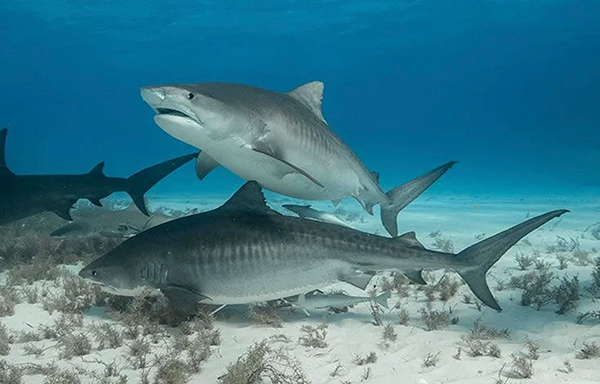
 I've dived all over the world and
seen plenty of sharks, but I never became
completely comfortable with these tigers,
though my fear was manageable. After all,
Tiger Beach has had a few accidents.
I've dived all over the world and
seen plenty of sharks, but I never became
completely comfortable with these tigers,
though my fear was manageable. After all,
Tiger Beach has had a few accidents.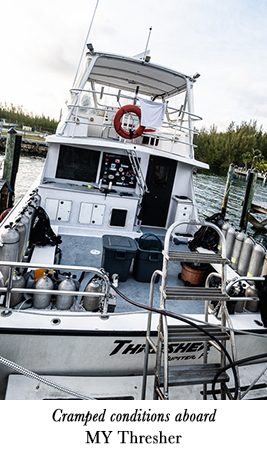 Diving Tiger Beach requires divers to kneel on
the sandy bottom at 20-30 feet, and to do so one must
be significantly overweighted. When wearing a 5mm
wetsuit, I usually carry 14 pounds of lead, but for
my first dive, I toted 25 pounds. However, that was
not enough to kneel in a controlled manner in a strong
current. The next dive, I added five more pounds,
which did allow me to sit and kneel.
Diving Tiger Beach requires divers to kneel on
the sandy bottom at 20-30 feet, and to do so one must
be significantly overweighted. When wearing a 5mm
wetsuit, I usually carry 14 pounds of lead, but for
my first dive, I toted 25 pounds. However, that was
not enough to kneel in a controlled manner in a strong
current. The next dive, I added five more pounds,
which did allow me to sit and kneel.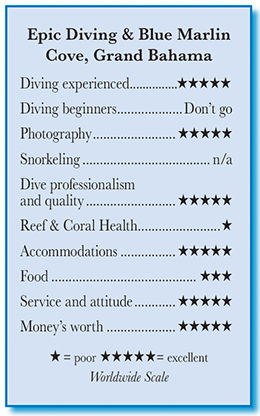 Epic Diving is run by Vinny and Deb Canabel, who established the operation several years ago after learning about shark feeding from friends in Mexico. Like so much about Tiger Beach, Deb and Vinny have unique backgrounds: Vinny is a board-certified emergency room physician who works in emergency rooms when they return to the U.S. during the July-October off-season. Deb has a Ph.D. in Neuroscience. I can't think of a better pair to have around when diving with 14-foot tiger sharks.
 The shark feeders bring the sharks in and work to keep them there so the divers can see them, while keeping the sharks calm. They know the sharks well and have even named some (Emma and Butt Face), so they're adept at keeping them moving in a calm flow to the bait box, then away from it and back around for another pass. The slow-moving sharks were easily fed from the bait box, and Vinny and Deb routinely petted them.
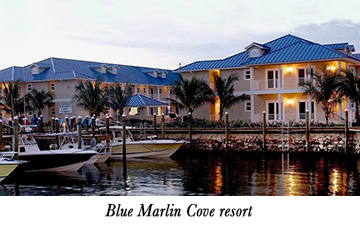
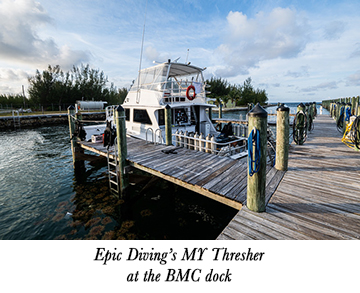 The Thresher docks at Blue Marlin Cove (BMC) on Grand Bahama Island. BMC is primarily a sport fishing resort with about 40 slips. BMC's condos are clean and spacious, featuring two large bedrooms, each with a walk-in closet and en-suite bathroom. I was assigned a "roommate," but since we both had our own ensuite baths and closets, it mostly felt like I had my own place. There's a full-sized living room and dining room, as well as a full kitchen with granite countertops. The fold-out couch and half bath off the living room mean the condo can accommodate up to 6 people. There's a nice balcony off the living room, but without furniture, so we never used it. A small touch I appreciated was a drip coffee pot and filters, but remember to bring coffee. The plugs and current are U.S.-style, and BMC treats its water, so there were no problems on that score. Each condo has its own laundry room, equipped with a washer/dryer stack unit and a one-load box of detergent.
 DIVER'S COMPASS: My 4-night stay at BMC plus three days of diving with Epic cost $2,495 for my own room and bath in a large, two-bedroom/two-bath condo . . . Depending on the type of aircraft, the flight from Miami or Nassau to Freeport and Grand Bahama is about 30 minutes . . . BMC has no gift shop, but there's a small one at a harbor where the boat stops for fuel . . . The resort WIFI is slow and hard to access . . . There is no nightlife at the resort, but after four hours on the boat; two long shark dives; and plenty of adrenaline pumping, I was ready to crash . . . The 30-minute taxi ride (plus shopping time) costs $80. . . Epic Diving
I want to get all the stories! Tell me how I can become an Undercurrent Online Member and get online access to all the articles of Undercurrent as well as thousands of first hand reports on dive operations world-wide

| Home | Online Members Area | My Account |
Login
|
Join
|
| Travel Index |
Dive Resort & Liveaboard Reviews
|
Featured Reports
|
Recent
Issues
|
Back Issues
|
|
Dive Gear
Index
|
Health/Safety Index
|
Environment & Misc.
Index
|
Seasonal Planner
|
Blogs
|
Free Articles
|
Book Picks
|
News
|
|
Special Offers
|
RSS
|
FAQ
|
About Us
|
Contact Us
|
Links
|
3020 Bridgeway, Ste 102, Sausalito, Ca 94965
All rights reserved.